
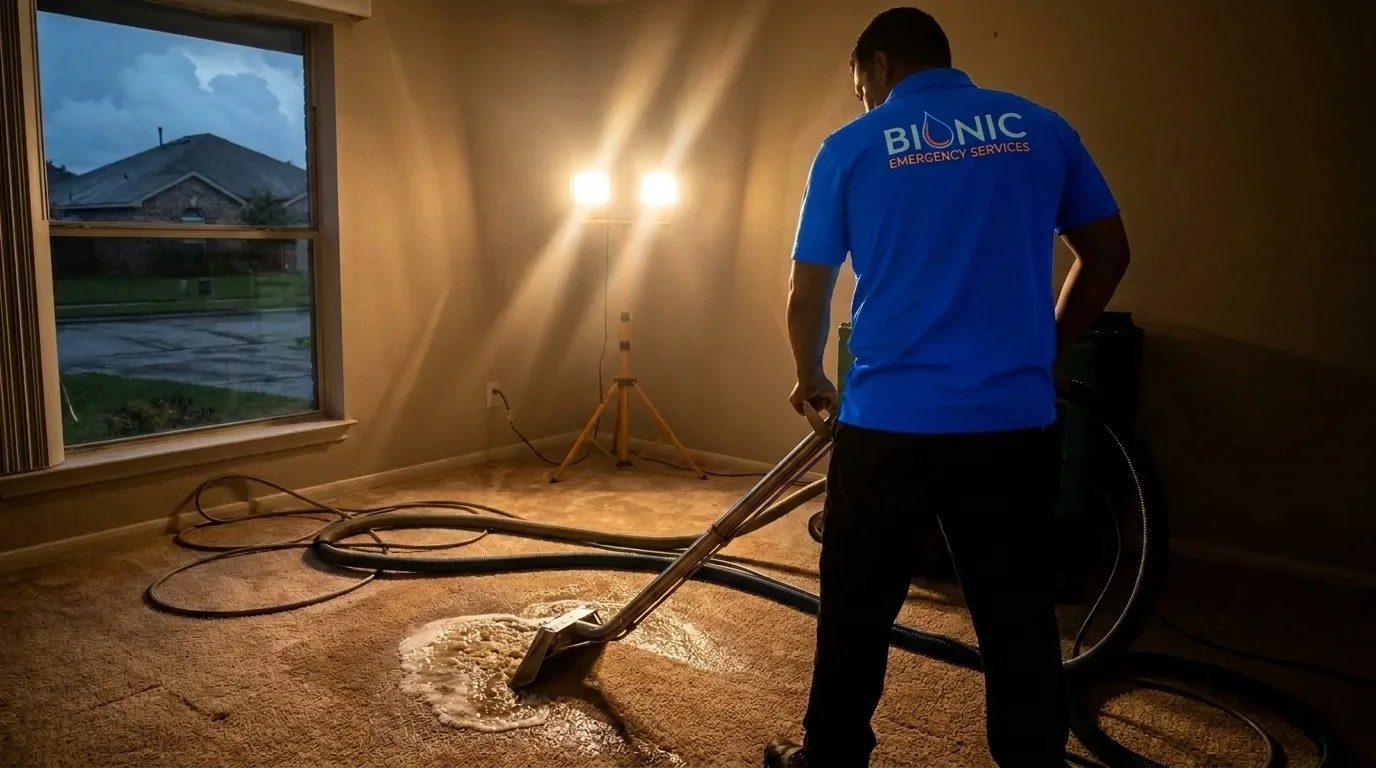
Emergency Water Removal & Cleanup in South Houston
Emergency water removal & cleanup in South Houston, TX. IICRC-trained technicians, insurance billing accepted. Call (713) 338-2424.
Our IICRC-certified technicians are dispatched from our Houston, TX headquarters and are typically on-site in South Houston within 60 minutes of your call.
Water damage emergency in South Houston? Call now for emergency service. Our crews bring truck-mounted extraction equipment and IICRC-trained technicians to pull standing water, get air moving, and start the drying clock before it works its way into subfloor, insulation, and drywall that Gulf Coast humidity won’t let dry on its own.
Why South Houston Properties See Water Damage Issues
South Houston sits on the flat, low-lying terrain typical of southeast Harris County, inside the broader Sims Bayou watershed that drains a large stretch of the region. That geography means rain doesn’t run off so much as it sits, and heavy clay soil common across the Gulf Coast swells and shifts with moisture, which stresses slab foundations and the plumbing lines running beneath them. A lot of the city’s housing stock dates to the postwar decades, when slab-on-grade construction became standard, so a slab leak or a sewer line failure often shows up first as a damp or warped spot on the floor rather than an obvious puddle. Add in a hurricane season that regularly brings tropical storm rainfall and a water table that stays high much of the year, and you get a city where water intrusion, whether from a burst supply line, a failed water heater, or storm surge pushing through a low entry point, tends to spread fast and linger in building materials longer than homeowners expect.
Our Emergency Water Removal Process
We start with extraction, pulling standing water with truck-mounted and portable pumps before it has a chance to wick further into baseboards, cabinetry, and carpet pad. From there we moisture-map the affected rooms, checking subfloor and wall cavities with meters rather than guessing from surface appearance, since a slab or wall can read dry at the top while the material underneath stays saturated. Air movers and dehumidifiers go in next, sized to the room and set up according to IICRC S500 drying standards, and we track readings daily until materials hit a stable dry standard rather than just “looks dry.” In homes with slab foundations, which describes a large share of South Houston’s housing stock, we also watch for signs the water source was a slab leak rather than surface flooding, since that changes both the repair plan and who ends up paying for it.
Reaching South Houston from Houston
We run crews out of Houston and into South Houston regularly, typically via I-45 South or Loop 610 depending on where the job sits relative to the rest of our schedule that day. Because South Houston is a tightly built, mostly residential city bordered by industrial and rail corridors, we coordinate ahead on street access for larger extraction trucks, especially on blocks with narrow lots or limited off-street parking. Call as soon as you notice water, standing water that sits for more than a few hours in Houston’s humidity lets secondary damage set in, and the sooner we’re on-site, the more of your flooring, drywall, and belongings we can typically save instead of replace.
South Houston Insurance Coordination
Most water losses here fall into one of two buckets for insurance purposes: sudden and accidental (a burst pipe, a failed appliance hose) or flood-related, which usually requires separate flood coverage given the area’s drainage patterns. We document the source, the affected materials, and our moisture readings throughout the job, which gives adjusters what they need regardless of which type of claim you’re filing. If your home has had prior water events, which isn’t unusual on this side of Harris County, it’s worth mentioning that history to your adjuster up front, since repeat claims in the same area sometimes draw extra scrutiny.
Local note
One thing we watch for specifically in South Houston: homes with cast iron or clay sewer laterals, common in construction from the city’s mid-century growth period, are more prone to root intrusion and slow collapse than the PVC lines in newer builds. A “water removal” call that starts as a simple supply line leak sometimes turns out to be a backed-up lateral once we get flooring up, which changes both the cleanup protocol and the conversation with your insurer.
If water is spreading across your floors right now, don’t wait on it to dry on its own, Houston humidity won’t let it. Call BIONIC Emergency Services for water extraction and cleanup built around how South Houston homes actually fail, from slab leaks to storm intrusion, and get a crew working on the problem instead of a quote on the phone.
Serving South Houston from our Houston headquarters — ★ 4.9 · 154 Google reviews
“They were very through and did a beautiful job! I highly recommend their services!” — Jim, August 2026Read our reviews on Google →
Emergency Water Removal & Cleanup in South Houston: Service Coverage
Frequently Asked Questions
How fast can you arrive for emergency water removal & cleanup in South Houston?
How does South Houston's clay soil and high water table affect water removal after a leak?
Are slab foundation homes in South Houston more prone to water damage than homes elsewhere?
Will you document a South Houston water loss for both standard and flood insurance claims?
What's different about drying out a South Houston home versus a quick surface cleanup?
Do older sewer lines in South Houston complicate water cleanup and extraction?
Emergency Water Removal & Cleanup response in South Houston
Most South Houston calls see a technician on-site within 60 minutes from our Houston headquarters.
Nearby & Related
- 24/7 Emergency Water Removal & Cleanup in Houston
- Restoration Services in South Houston
- Emergency Water Damage Restoration in South Houston
- Commercial Restoration in South Houston
- Emergency Water Removal & Cleanup in Baytown
- Emergency Water Removal & Cleanup in Cloverleaf
- Contact BIONIC Emergency Services