
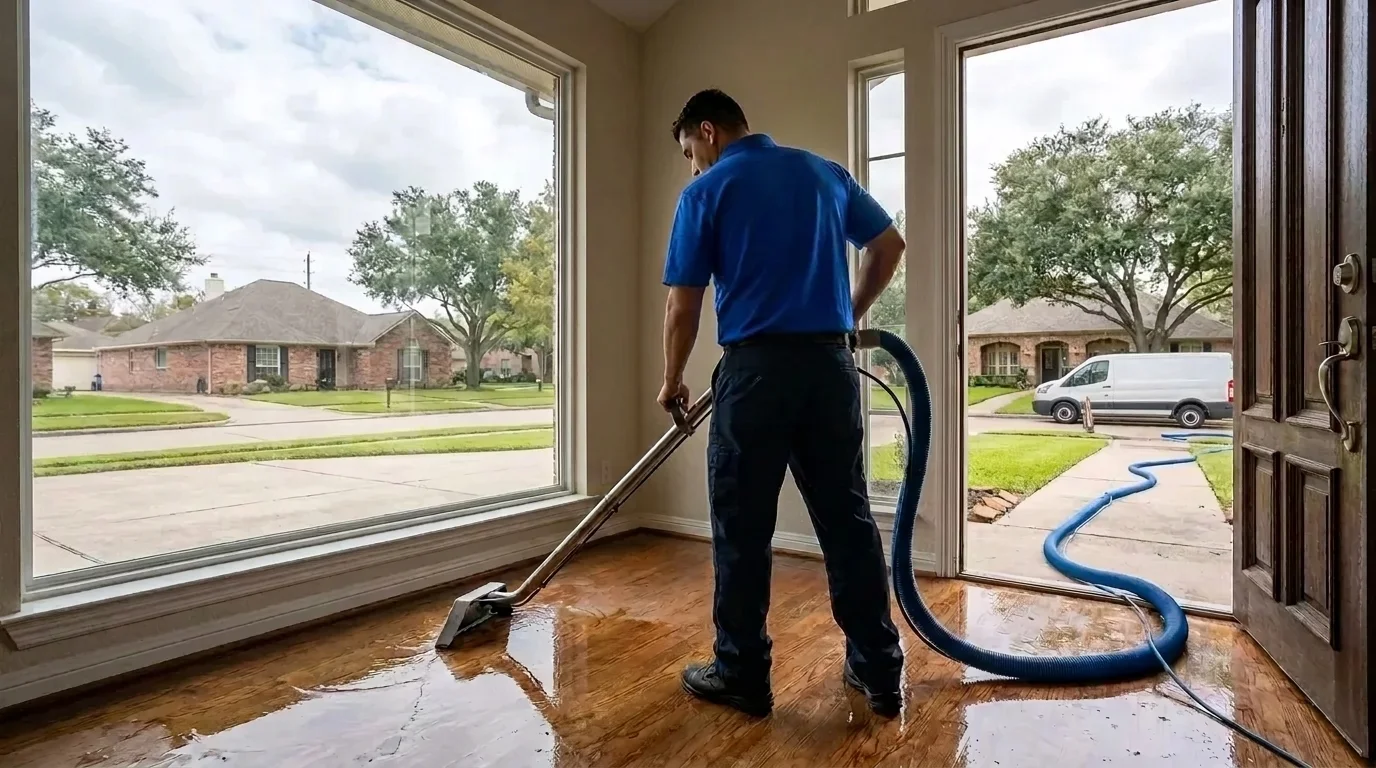
24/7 Emergency Flood Damage Restoration in Houston
24/7 emergency flood damage restoration in Houston and surrounding areas. IICRC-trained technicians, insurance billing accepted. Call (713) 338-2424.
Flood damage in Houston? Call now for emergency service at (713) 338-2424. Floodwater from a overflowing bayou, a failed sump pump, or a storm surge backing up through the slab behaves differently than a clean supply-line break, and treating it the same way is how homes end up with hidden contamination weeks later.
Floodwater is almost always Category 2 or 3 water, meaning it has picked up soil, sewage, or chemical runoff on its way into the structure. That changes everything about how the job gets scoped, what materials can be saved, and what has to come out.
What flood damage restoration actually involves
Flood cleanup starts with water that has already been sitting, sometimes for hours, sometimes for a day or more if the home was inaccessible during the storm. That changes the job from the moment crews walk in. Standing floodwater carries silt, bacteria, and sometimes fuel or sewage runoff, so the work isn’t just extraction and drying, it’s extraction, targeted demolition, and sanitizing the structure before drying even starts.
Crews use truck-mounted extractors for standing water, then move to flood cuts on drywall, removal of saturated insulation and baseboards, and antimicrobial application on framing and subfloor. Drying runs on air movers and dehumidifiers with moisture readings tracked daily until wood moisture content and relative humidity return to normal range, which on a flooded slab home can take longer than a standard water loss because the concrete itself holds moisture.
Our process
- Water categorization and safety check. Before anything else gets moved, we identify the source and category of the water, floodwater is treated as Category 2 or 3 by default, which determines PPE and what materials are salvageable.
- Extraction. Standing water is pumped and extracted first, since every hour it sits raises the contamination load on flooring, drywall, and cabinetry.
- Flood cuts and controlled demolition. Drywall, baseboard, and insulation below the waterline are removed in a clean, measured line, not torn out haphazardly, which keeps the repair scope smaller and documented for the adjuster.
- Antimicrobial treatment and structural drying. Exposed framing and subfloor are treated, then dried per the IICRC S500 standard with air movers and dehumidifiers positioned by room size and material type.
- Moisture monitoring to dry standard. Daily moisture readings continue until framing, subfloor, and slab moisture content read within normal range, not just until the surface feels dry.
What separates a good flood damage response from a bad one
The most common mistake is drying a flooded room without removing enough material first. Carpet pad left in place, baseboard not pulled, or insulation left wet behind the wall all trap moisture that no amount of air movement will reach, and it shows up as odor or soft drywall weeks later. Adjusters know to check for this, and a scope that skips it tends to get flagged during claim review.
A second gap is treating floodwater like a clean water loss. Skipping antimicrobial application on framing because “it’ll dry fine” ignores what was actually in the water. A thorough response documents the water category, photographs the flood line before demolition, and keeps moisture logs that show the drying was verified, not assumed.
What does flood damage restoration cost?
Costs vary with how much water intruded, how long it sat before cleanup started, and how much demolition the contamination level requires. Every loss gets a written scope before work begins, because two flooded rooms can need very different work depending on category of water and how saturated the subfloor and framing turned out to be. Homeowners insurance typically covers flood-driven water damage only if the policy includes flood coverage (standard homeowners policies usually exclude flood from external sources, though a line break or storm-driven roof failure may be covered differently), so confirming the coverage source matters before work starts.
| Scenario | Typical range |
|---|---|
| Single room, shallow water, quick response | $1,500 - $4,000 |
| Multiple rooms, water sat 24+ hours | $4,000 - $9,000 |
| Whole first floor, Category 3 contamination | $9,000 - $20,000+ |
| Flood cuts and drywall removal, per room | $800 - $2,000 |
| Subfloor replacement after prolonged saturation | $2,500 - $6,000+ |
Seasonal & regional considerations
Houston sits low and flat, with clay soils that drain slowly and a bayou system that backs up fast during heavy rainfall. Hurricane season brings the highest flood risk, but even a strong spring thunderstorm can push water into homes near the bayous or in low-lying subdivisions with older storm drainage. Slab foundations, common across the region, mean floodwater has nowhere to go but up into drywall and cabinetry, which is part of why flood cuts here often run higher on the wall than in homes with raised foundations.
Service area
BIONIC Emergency Services handles flood damage restoration across Houston and the surrounding communities, including areas along the bayou corridors and the outlying suburbs that see repeat flooding during heavy rain events.
If water has already come through your floors or walls, don’t wait on drying decisions. Schedule your flood damage assessment with a team that documents the loss correctly from the first visit.
Frequently Asked Questions
Does homeowners insurance cover flood damage restoration?
How is floodwater different from a burst pipe for restoration purposes?
Can carpet and drywall be saved after a flood, or does everything get replaced?
How long does flood damage drying typically take?
What should I do with flooded belongings while waiting for restoration crews?
Looking for the best flood damage restoration company in Houston?
BIONIC Emergency Services provides flood damage restoration in Houston, TX and the surrounding area, and has served local property owners since 2011. Customers rate us 4.9 out of 5 stars across 154 Google reviews. We answer calls 24/7 — call (713) 338-2424 for immediate help.
Need Flood Damage Restoration now?
We respond 24/7 across Houston and surrounding TX cities.