
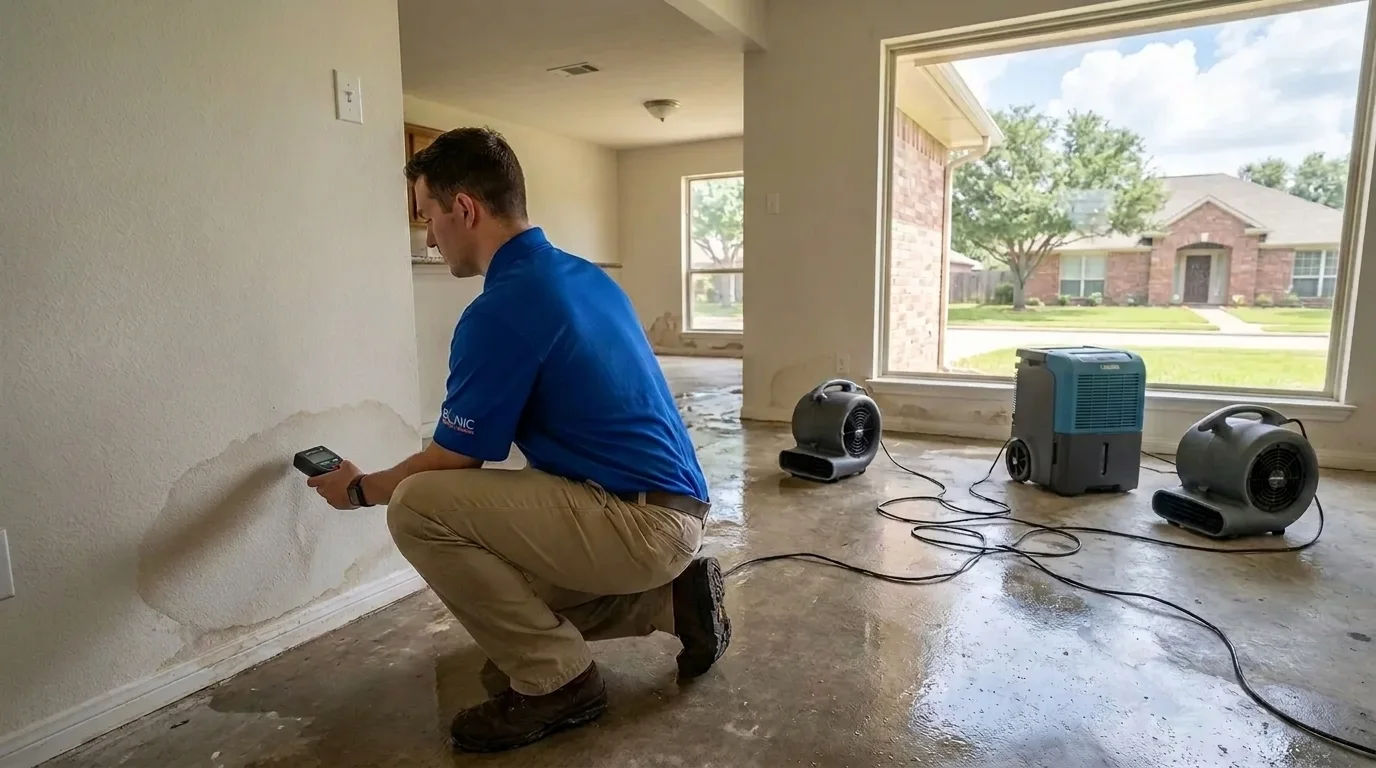
24/7 Emergency Water Damage Restoration in Houston
24/7 emergency water damage restoration in Houston and surrounding areas. IICRC-trained technicians, insurance billing accepted. Call (713) 338-2424.
Water damage emergency in Houston? Call now for emergency service. Standing water that sits under baseboards for more than a few hours starts wicking into drywall and framing, and once the humidity inside a closed-up room climbs past the point where materials can air-dry on their own, you’re no longer dealing with a cleanup job, you’re dealing with a drying problem that needs equipment and monitoring, not just mops and fans.
What water damage restoration actually involves
Water damage restoration is the combination of pulling out standing or trapped water (extraction), removing the moisture that’s already absorbed into building materials (structural drying), and verifying the structure is actually back to a safe moisture level before anyone closes the walls back up. That last part gets skipped more than it should. Drywall, subfloor, and framing lumber all hold moisture differently, and a room can feel dry to the touch while a moisture meter reading on the bottom plate still says otherwise. Our technicians carry IICRC WRT and ASD training, which means the drying plan is built around psychrometry, not guesswork: dehumidifier sizing matched to the cubic footage of the space, air mover placement that actually creates a drying pattern across wet surfaces, and daily moisture readings logged until the materials hit a dry standard, not just a dry feeling.
Category matters too. Clean water from a supply line behaves differently than water that backed up through a floor drain or sat for days and turned gray. Category 2 and 3 water carries contamination risk that changes what can be dried in place versus what has to be removed and replaced, and it changes the containment and PPE used on site.
Our process
- Moisture assessment and source control. Before anything else, we find where the water is coming from and confirm it’s stopped, then map how far it traveled using moisture meters and thermal imaging, not just a visual walk-through.
- Extraction. Standing water comes out first with truck-mount or portable extraction equipment, pulling as much free water as possible before drying equipment ever gets turned on, since extraction is faster and cheaper than evaporation.
- Structural drying setup. Air movers and dehumidifiers get placed based on the size and shape of the affected area, with flooring and baseboards detached where needed so trapped water behind them can actually dry instead of staying sealed in.
- Containment for Category 2/3 water. When the water source is contaminated, we isolate the affected area with poly barriers and negative air where appropriate to keep the cleanup from spreading contamination into dry parts of the structure.
- Moisture monitoring and sign-off. Daily readings track progress until materials reach an acceptable dry standard, and we document that end point so there’s a clear record the structure is actually dry, not just dry enough to stop looking.
What separates a good water damage response from a bad one
The most common mistake is drying the surface and missing the cavity. A wall can read dry with a surface pinless meter while the insulation and bottom plate inside it are still saturated, and if drying equipment gets pulled too early, secondary damage can start in damp material within 24 to 48 hours. A careful response checks moisture inside wall cavities, under flooring, and in subfloor material, not just where water is visible.
Adjusters look for documented moisture logs, photos of the loss at each stage, and a clear equipment placement rationale, not just a final invoice. Restoration work that’s billed accurately and supported by that kind of documentation moves through claims faster and gets questioned less. Underpowered equipment is another common shortfall: a dehumidifier sized for a bedroom doesn’t do much in an open great room, and air movers aimed without a drying pattern in mind just push humid air around instead of pulling moisture out of materials.
What does water damage restoration cost?
Costs vary by category of water, square footage affected, how long the area sat wet before drying started, and whether materials like drywall or flooring need to be removed rather than dried in place. These are typical industry ranges, not a quote, every loss is different and BIONIC Emergency Services provides a written scope before work begins. Homeowners insurance typically covers sudden and accidental water damage, such as a burst pipe or failed appliance hose, though gradual leaks and flood-related water are usually excluded or handled under separate flood coverage.
| Scenario | Typical range |
|---|---|
| Single room, clean water, caught early | $1,200 - $3,500 |
| Multi-room clean water with flooring removal | $3,000 - $7,500 |
| Category 2 water with partial drywall removal | $4,500 - $9,000 |
| Category 3 water (sewage/flood) with containment | $7,000 - $15,000+ |
| Whole-floor loss with structural drying equipment for several days | $10,000 - $25,000+ |
Seasonal & regional considerations
Houston’s humidity works against structural drying for most of the year, since outdoor air often holds as much or more moisture than the wet materials indoors, which is why dehumidification equipment matters more here than in drier climates. Winter freeze events are less frequent but not rare, and when pipes do freeze and burst in homes built without insulated exterior walls, the water damage can spread through multiple rooms before anyone’s home to catch it. Heavy rain events and the region’s slow-draining clay soils also mean slab leaks and foundation-level moisture intrusion show up more often than in areas with better natural drainage.
Service area
BIONIC Emergency Services responds to water damage calls throughout Houston and the surrounding area. Coverage details for nearby communities are listed on each city-specific page.
If water is actively spreading through your home or business right now, stop reading and call (713) 338-2424 to schedule your moisture assessment before drywall, flooring, or framing absorb more than they already have.
Services We Handle
- Water Mitigation
- Wet Carpet Drying
Frequently Asked Questions
Does homeowners insurance cover water damage restoration?
How long does structural drying typically take?
What's the difference between water extraction and structural drying?
Do I need to remove drywall or flooring after water damage?
What should I do while waiting for a water damage technician?
Looking for the best water damage restoration company in Houston?
BIONIC Emergency Services provides water damage restoration in Houston, TX and the surrounding area, and has served local property owners since 2011. Customers rate us 4.9 out of 5 stars across 154 Google reviews. We answer calls 24/7 — call (713) 338-2424 for immediate help.
Need Water Damage Restoration now?
We respond 24/7 across Houston and surrounding TX cities.
Related Coverage
- Our Restoration Services
- Contact BIONIC Emergency Services
- 24/7 Emergency Water Damage Restoration in Baytown
- 24/7 Emergency Water Damage Restoration in Katy
- 24/7 Emergency Water Damage Restoration in Missouri City
- 24/7 Emergency Water Damage Restoration in Pasadena
- 24/7 Emergency Water Damage Restoration in Pearland
- 24/7 Emergency Water Damage Restoration in Spring
- 24/7 Emergency Water Damage Restoration in Sugar Land
- 24/7 Emergency Water Damage Restoration in The Woodlands
- 24/7 Emergency Water Removal & Cleanup in Houston
- 24/7 Emergency Water Cleanup in Houston
- Burst Pipe Emergency Checklist: Step-by-Step Response
- What To Do in the First 24 Hours After Water Damage
- How To Choose a Restoration Company in Houston (Without Getting Burned)
- Emergency Water Damage Restoration in Hockley
- Emergency Water Damage Restoration in Jacinto City
- Emergency Water Damage Restoration in Rosenberg
- Emergency Water Damage Restoration in Sealy