
24/7 Emergency Water Removal & Cleanup in Houston
24/7 emergency water removal & cleanup in Houston and surrounding areas. IICRC-trained technicians, insurance billing accepted. Call (713) 338-2424.
Water pooling across your floors right now? Call (713) 338-2424. We answer 24/7, and every hour that water sits against drywall, flooring, or subfloor is an hour closer to secondary damage, which can begin in as little as 24 to 48 hours in Houston’s humidity.
Standing water doesn’t stay where you can see it. It wicks up drywall, pools under laminate and tile, and soaks into subfloor and joists long before the surface looks wet. A supply line failure, slab leak, or storm intrusion can leave a room looking fine at a glance while the materials underneath are already saturated. Emergency water removal and cleanup is the work of getting that water out fast, confirming what’s actually wet versus what just looks wet, and drying the structure before it becomes a bigger job.
What emergency water removal & cleanup actually involves
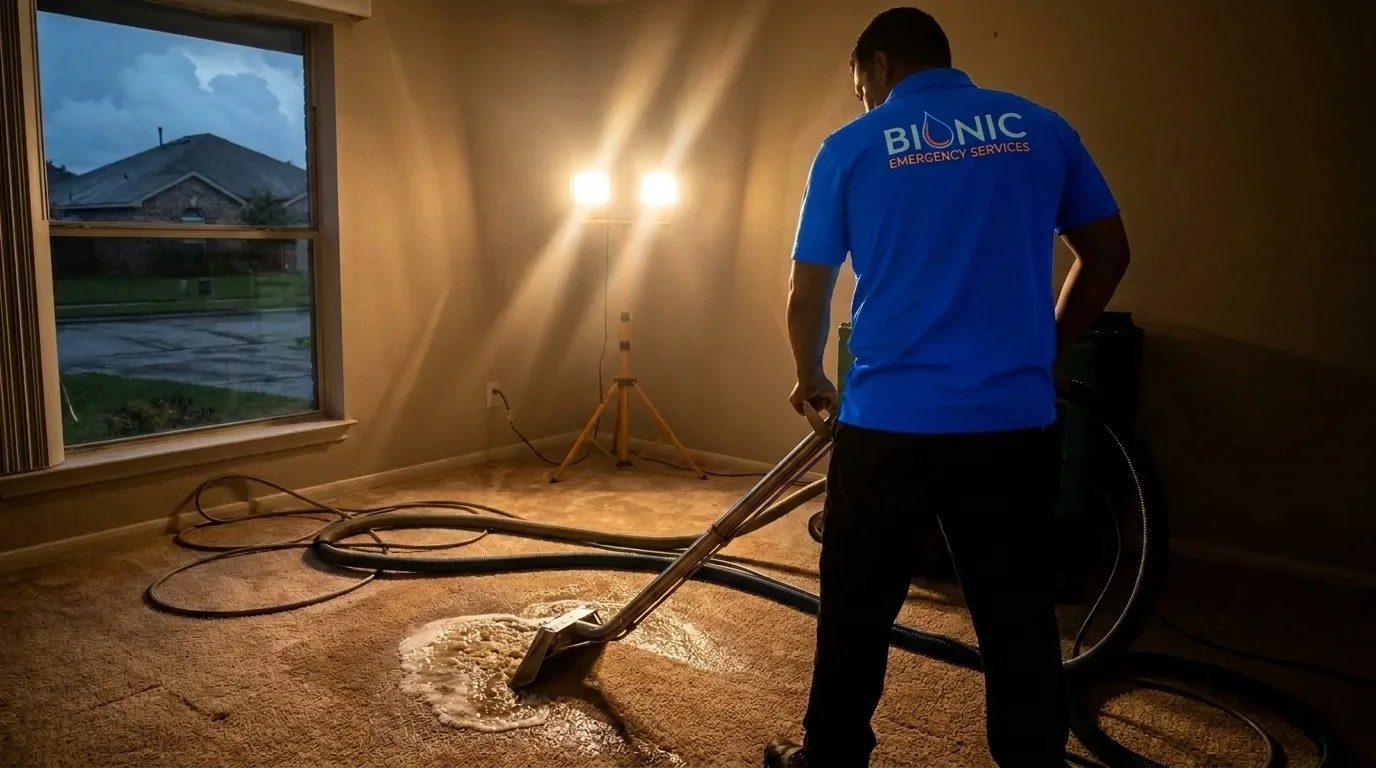
This is the extraction and drying phase that follows any water intrusion, whether it’s a burst pipe, a failed water heater, roof leak, or floodwater from a storm. The work starts with pulling standing water off floors and out of carpet with truck-mounted or portable extraction units, then moves into structural drying using air movers, dehumidifiers, and moisture monitoring. The category of water matters here. Clean water from a supply line (Category 1) is handled differently than water that’s picked up contaminants from groundwater or sewage backup (Category 2 or 3), which requires antimicrobial treatment and sometimes removal of porous materials that can’t be sanitized.
Timeline depends on how saturated the structure is and how quickly extraction starts. A single wet room with prompt extraction might dry in 3 to 5 days. A multi-room loss with wet subfloor or saturated drywall cavities can run a week or more, with daily moisture checks until readings return to a dry standard.
Our process
- Standing water extraction. Submersible pumps and extraction wands remove bulk water from floors, carpet, and carpet pad before any drying equipment goes in.
- Moisture mapping. Moisture meters and thermal imaging identify where water has traveled, including inside wall cavities and under flooring that looks dry on the surface.
- Drying equipment placement. Air movers and low-grain-refrigerant dehumidifiers are set based on the moisture map, not a flat room count, so wet cavities actually get airflow.
- Containment and treatment for Category 2/3 water. Where water is contaminated, affected porous materials are removed and antimicrobial treatment is applied per IICRC S500 guidelines before drying continues.
- Daily monitoring. Moisture readings are logged until materials hit dry standard, which is also the documentation your insurance adjuster will want to see.
What separates a good water removal response from a bad one
The most common mistake is drying to the eye instead of drying to a meter. A room can look and feel dry while the subfloor or wall cavity underneath still holds moisture, and if equipment gets pulled early, rot and odor show up two weeks later. Another frequent miss is skipping moisture mapping altogether and placing air movers evenly around a room instead of targeting where the water actually traveled, which wastes drying time and leaves hidden pockets wet.
Adjusters generally want to see daily drying logs with psychrometric readings, not just a final “dry” checkmark. They also look for documentation of the water category at time of loss, since that determines what materials had to be removed versus dried in place. A response that skips this paperwork tends to run into coverage disputes later, even when the actual drying work was done correctly.
What does emergency water removal & cleanup cost?
Costs vary with how much water intruded, how far it traveled, and whether materials need to be removed versus dried in place. These are typical industry ranges, not a quote. Every loss is different, and BIONIC Emergency Services provides a written scope before any work begins. Homeowners insurance typically covers sudden, accidental water damage (a burst pipe or appliance failure) but usually excludes gradual leaks or flooding from an outside source without separate flood coverage.
| Scenario | Typical range |
|---|---|
| Single room, clean water, prompt extraction | $1,200 - $3,500 |
| Multi-room flooding, clean to gray water | $3,500 - $8,000 |
| Category 3 water (sewage backup) | $5,000 - $12,000 |
| Drywall flood cuts and structural drying | $2,000 - $6,000 |
| Whole-house flooding | $10,000 - $30,000+ |
Seasonal & regional considerations
Houston’s humidity keeps ambient moisture high most of the year, which slows natural drying and makes mechanical dehumidification more important than it would be in a drier climate. Heavy rain events and hurricane season bring the highest volume of water intrusion calls, often from roof leaks and storm surge rather than plumbing failures. The region’s clay soil also shifts seasonally, which stresses slab foundations and can open small gaps where ground water tracks in during heavy rain, a different source than a pipe failure but one that needs the same extraction and drying response.
Service area
BIONIC Emergency Services responds to water emergencies across Houston and the surrounding communities throughout Harris County and the greater Gulf Coast region.
If you’re standing over wet flooring right now, don’t wait for it to dry on its own. Call (713) 338-2424 to schedule emergency water removal and get drying equipment on-site before the damage spreads further into your walls and subfloor.
Services We Handle
- Standing Water Removal
Frequently Asked Questions
Does homeowners insurance cover emergency water removal and cleanup?
How do you know if water damage is Category 1, 2, or 3?
Will my carpet and drywall survive water damage or do they have to be replaced?
How long does it take to dry out a house after a water loss?
What should I do while waiting for emergency water removal to start?
Looking for the best emergency water removal & cleanup company in Houston?
BIONIC Emergency Services provides emergency water removal & cleanup in Houston, TX and the surrounding area, and has served local property owners since 2011. Customers rate us 4.9 out of 5 stars across 154 Google reviews. We answer calls 24/7 — call (713) 338-2424 for immediate help.
Need Emergency Water Removal & Cleanup now?
We respond 24/7 across Houston and surrounding TX cities.
Related Coverage
- Our Restoration Services
- Contact BIONIC Emergency Services
- 24/7 Emergency Water Damage Restoration in Houston
- 24/7 Emergency Water Cleanup in Houston
- Emergency Water Removal & Cleanup in Conroe
- Emergency Water Removal & Cleanup in Pasadena
- Emergency Water Removal & Cleanup in Pearland
- Emergency Water Removal & Cleanup in Sugar Land