
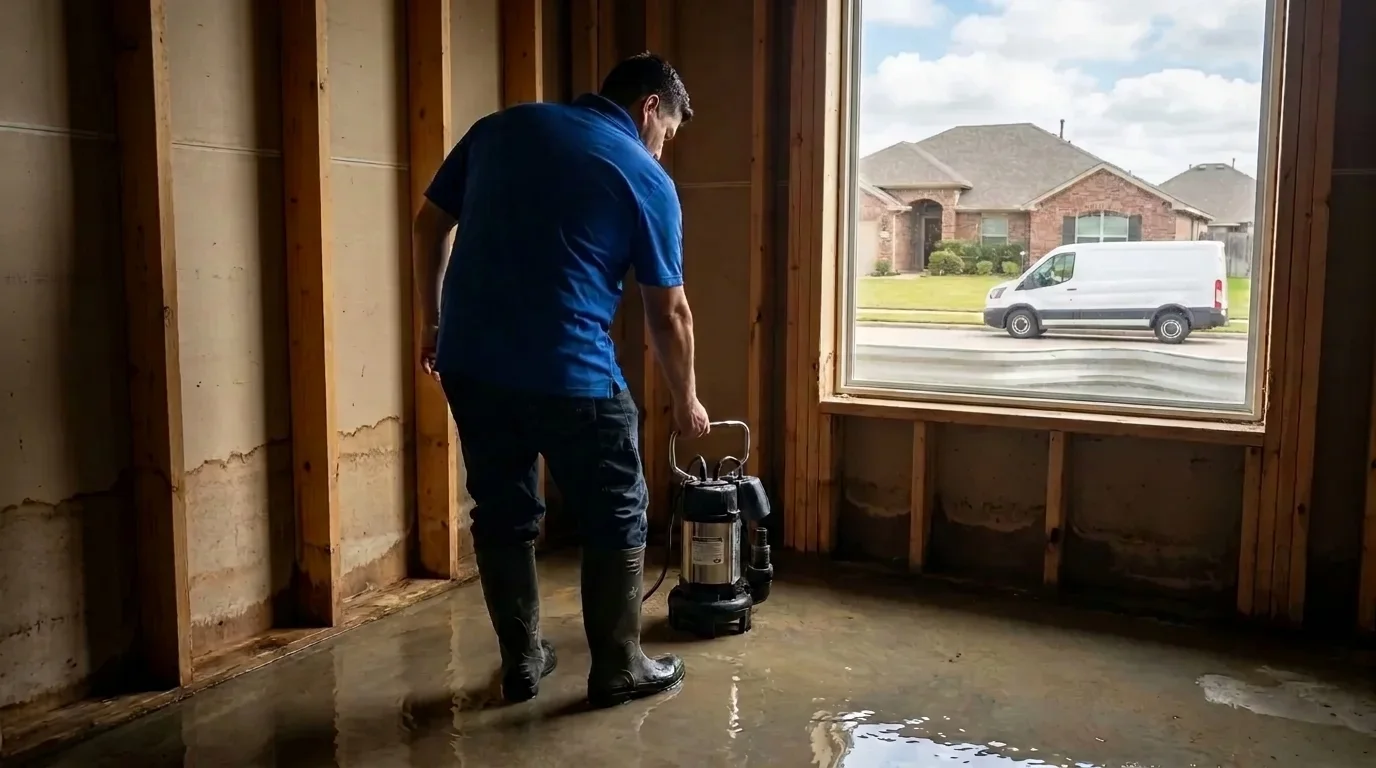
24/7 Emergency Basement Flooding Cleanup in Houston
24/7 emergency basement flooding cleanup in Houston and surrounding areas. IICRC-trained technicians, insurance billing accepted. Call (713) 338-2424.
Basement flooding in Houston? Call now for emergency service at (713) 338-2424. Basements are uncommon here because of the high water table and expansive clay soils, so when a basement, cellar, or below-grade space does take on water, it’s usually because hydrostatic pressure has pushed water through a foundation crack, a sump pump has failed during a heavy rain event, or a sewer line has backed up under slab. Standing water in an enclosed below-grade space reads differently than water in a living room: it has nowhere to evaporate, the walls are already damp from soil contact, and secondary damage can start in framing and drywall within 24 to 48 hours.
What basement flooding cleanup actually involves
This isn’t the same job as drying out a flooded kitchen. Below-grade spaces trap humidity against concrete and masonry that are often already near saturation from ground contact, so the drying target is lower and the timeline is usually longer. Work typically includes pumping or extracting standing water, removing saturated baseboard, drywall, and flooring that can’t be salvaged, running commercial dehumidifiers sized for the cubic footage and the concrete’s moisture load, and tracking drying progress with a moisture meter against the dry standard before any rebuild starts. If the water came from a sewer backup or sat for more than 48 hours, it’s treated as a contaminated loss and handled with different PPE and disposal procedures than a clean-water event.
Our process
- Safety and source check. Before anyone steps into standing water, we check for electrical hazards and identify whether the source is groundwater intrusion, a failed sump system, a plumbing leak, or sewage backup, since that determines the category of loss.
- Extraction. Submersible pumps and truck-mounted extraction remove bulk water fast, because every hour standing water sits against drywall and framing raises the amount that ends up needing to be cut out.
- Moisture mapping. We check moisture content in the slab, block or poured walls, and any framed sections, since concrete below grade can hold moisture well below what a surface check would suggest.
- Structural drying. Dehumidifiers and air movers are placed and monitored daily, with drying logged per the IICRC S500 standard, so the basement reaches a verified dry standard instead of just looking and smelling dry.
- Drainage and source correction notes. We document whether a sump pump, French drain, or foundation crack contributed, so the homeowner has a clear picture of what needs repair to prevent a repeat event.
What separates a good basement flooding response from a bad one
The most common mistake is drying to the surface and stopping early. Concrete and masonry release moisture slowly, and a basement that feels dry to the touch after two days can still be feeding moisture into baseboards and framing a week later, which is exactly how hidden rot and odor get started behind finished walls. A second common gap is skipping a real cause diagnosis: if a sump pump failed or a foundation crack is still open, drying the space without addressing the source just resets the clock until the next heavy rain. Adjusters reviewing a basement claim typically want documented moisture readings over multiple days, photos of removed materials, and a clear category classification for the water, not just a one-time “it’s dry” note.
What does basement flooding cleanup cost?
Costs vary with how much standing water was present, how long it sat, and whether the water was clean, gray, or contaminated by sewage. Every loss gets a written scope before work begins, since the right number depends on square footage, what materials were affected, and drying time, not a flat rate. Most homeowners insurance policies cover sudden water damage from a burst pipe or appliance failure, but groundwater seepage and sewer backups are often excluded unless a separate endorsement was purchased, so it’s worth checking your policy language before assuming coverage.
| Scenario | Typical range |
|---|---|
| Small basement, clean water, caught early | $1,500 - $3,500 |
| Moderate flooding, partial drywall and flooring removal | $3,500 - $8,000 |
| Large basement, extended standing water, contents loss | $8,000 - $15,000 |
| Sewage backup, contaminated water, full material removal | $6,000 - $14,000 |
| Structural drying only, no demolition needed | $1,200 - $3,000 |
Seasonal & regional considerations
Houston’s heaviest basement flooding risk tracks with its rainy season and tropical storm activity from roughly June through November, when slow-moving systems can drop several inches of rain in a short window and overwhelm sump systems and area drainage. The region’s clay-heavy soil swells when saturated, which raises hydrostatic pressure against foundation walls and is a common reason older basements and below-grade spaces develop new cracks after a wet stretch, even without a single major storm event.
Service area
BIONIC Emergency Services handles basement and below-grade water removal across Houston and the surrounding communities, from inner-loop neighborhoods with older housing stock to suburban areas where finished basements and below-grade utility rooms are more common.
If water is actively standing in your basement, schedule basement water removal now so extraction and moisture mapping can start before drying time and material loss increase.
Frequently Asked Questions
Does homeowners insurance cover basement flooding cleanup?
How can I tell if basement water is clean, gray, or contaminated?
How long does it take to dry out a flooded basement?
What should I do in the basement while waiting for help to arrive?
Looking for the best basement flooding cleanup company in Houston?
BIONIC Emergency Services provides basement flooding cleanup in Houston, TX and the surrounding area, and has served local property owners since 2011. Customers rate us 4.9 out of 5 stars across 154 Google reviews. We answer calls 24/7 — call (713) 338-2424 for immediate help.
Need Basement Flooding Cleanup now?
We respond 24/7 across Houston and surrounding TX cities.