
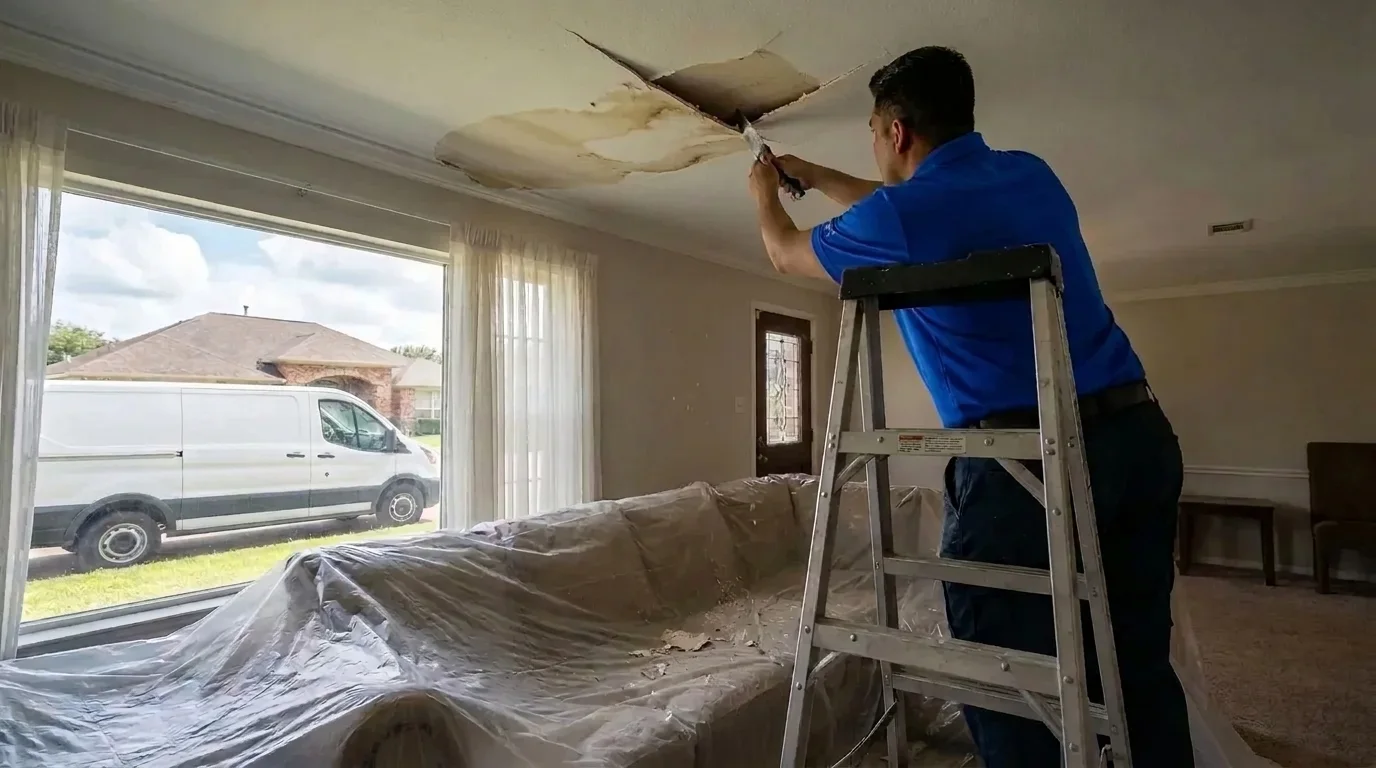
24/7 Emergency Ceiling Water Damage Repair in Houston
24/7 emergency ceiling water damage repair in Houston and surrounding areas. IICRC-trained technicians, insurance billing accepted. Call (713) 338-2424.
Water coming through your ceiling right now? Call (713) 338-2424. A sagging or actively dripping ceiling means water has already pooled in the cavity above it, and drywall or plaster can let go with very little warning. We answer 24/7, and the first priority on-site is always relieving that trapped weight safely before anyone worries about repairs.
A water stain on the ceiling almost never means the damage stops at what you can see. Whether it’s a slow roof leak that’s been staining the same corner for weeks or a burst supply line that just opened up overhead, the drywall or plaster, the insulation above it, and the framing members are all absorbing water at different rates. Left alone, a saturated ceiling section can start sagging within hours and collapsing within a day or two, especially in older Houston homes with plaster-and-lath construction that holds water longer than modern drywall.
What ceiling water damage repair actually involves
Ceiling water damage repair is really two jobs stacked on top of each other: stopping and drying out the hidden moisture, then rebuilding what the water ruined. The visible stain or sag is just the symptom. Behind it, you’re usually dealing with wet insulation (which loses most of its R-value once it’s saturated and rarely dries back to useful condition), wet framing or furring strips, and sometimes a wet subfloor if the source is a second-story bathroom or kitchen above. Equipment on a ceiling job typically includes moisture meters and sometimes thermal imaging to map how far the water has traveled laterally from the visible stain, air movers positioned to dry the cavity without blowing debris into the room, and in some cases a small access cut to extract standing water pooled in a sagging section before it’s structurally repaired.
Our process
- Controlled release of trapped water. If a section is visibly bellied or sagging, we relieve the pressure in a controlled way rather than letting it fail on its own, protecting flooring and furniture below.
- Source tracing. Roof penetration, a failed supply line, an HVAC condensate line, or a second-floor plumbing fixture all leave different clues. We confirm the source before any drying starts, because drying around an active leak is wasted work.
- Extraction and structural drying. Standing water and saturated insulation are removed, and the cavity is dried per the IICRC S500 standard using positioned air movement and monitored humidity.
- Moisture mapping and documentation. We track drying progress at the joists, drywall, and any adjoining wall cavities with daily readings, which also becomes the documentation your adjuster will ask for.
- Repair and finish. Damaged drywall or plaster sections are cut back to sound material, insulation is replaced where it was saturated, and the ceiling is patched, textured, and painted to match.
What separates a good ceiling water damage response from a bad one
The most common shortcut is patching the visible stain without opening the cavity to check how far the water traveled. Water follows joists and ductwork sideways, often several feet beyond where the stain shows on the ceiling surface, so a repair that only addresses the obvious spot frequently leaves wet insulation or framing behind the new drywall. That moisture doesn’t go anywhere on its own, and it’s exactly the kind of condition that shows up as rot, odor, or a repeat stain a few months later.
Adjusters reviewing a ceiling claim are generally looking for moisture readings taken before and after drying (not just a photo of the stain), a clear source determination, and documentation of what was actually removed versus salvaged. Homes built before 1978 add another wrinkle: textured ceilings in that era can contain lead, which changes how the material has to be handled during cutout rather than just scraped and re-textured.
What does ceiling water damage repair cost?
Costs depend heavily on how large the affected area is, whether insulation needs replacing, and whether the ceiling is drywall or older plaster and lath. These are typical industry ranges, not a quote: every ceiling loss gets its own written scope before work begins, since the extent of hidden moisture isn’t always clear until the cavity is opened.
| Scenario | Typical range |
|---|---|
| Small water stain, drywall patch, clean water source | $250 - $650 |
| Sagging ceiling section, drywall cutout and replacement | $800 - $2,500 |
| Full room ceiling tear-out with insulation replacement | $2,500 - $6,000 |
| Plaster or lath ceiling repair (pre-1960s homes) | $1,500 - $4,000 |
Homeowners insurance typically covers ceiling water damage when the source is sudden and accidental, like a burst pipe, but it commonly excludes damage traced to a long-term roof leak or deferred maintenance, so the source determination matters for your claim as much as it matters for the repair.
Seasonal & regional considerations
Houston’s ceiling leak calls follow a pattern. Heavy spring and hurricane-season rain drives roof and flashing leaks that show up as fresh ceiling stains days after a storm. Summer humidity pushes AC condensate lines to clog, and a clogged line backing up into a drain pan is one of the most common sources of a slow ceiling leak in homes with attic-mounted units. Winter freeze events, like the one in 2021, have also caused attic supply line breaks that soak ceilings from above with very little warning before the thaw.
Service area
We handle ceiling water damage repair for homeowners and property managers throughout Houston and the surrounding area, including homes with the plaster-and-lath construction common in the city’s older neighborhoods and the drywall-over-slab builds typical of newer suburbs.
If you’re staring at a new stain, a soft spot, or an actively dripping ceiling, don’t wait for it to tell you how bad it is on its own. Schedule your ceiling moisture assessment and we’ll map how far the water has actually traveled before anything gets cut open.
Frequently Asked Questions
Does homeowners insurance cover ceiling water damage repair?
My ceiling is sagging but hasn't leaked yet, is it safe to wait until morning?
How do you find the source of a ceiling leak if there's no obvious pipe above it?
Can wet insulation above a ceiling just be dried out instead of replaced?
Is a popcorn or textured ceiling repair handled differently in older Houston homes?
Looking for the best ceiling water damage repair company in Houston?
BIONIC Emergency Services provides ceiling water damage repair in Houston, TX and the surrounding area, and has served local property owners since 2011. Customers rate us 4.9 out of 5 stars across 154 Google reviews. We answer calls 24/7 — call (713) 338-2424 for immediate help.
Need Ceiling Water Damage Repair now?
We respond 24/7 across Houston and surrounding TX cities.