
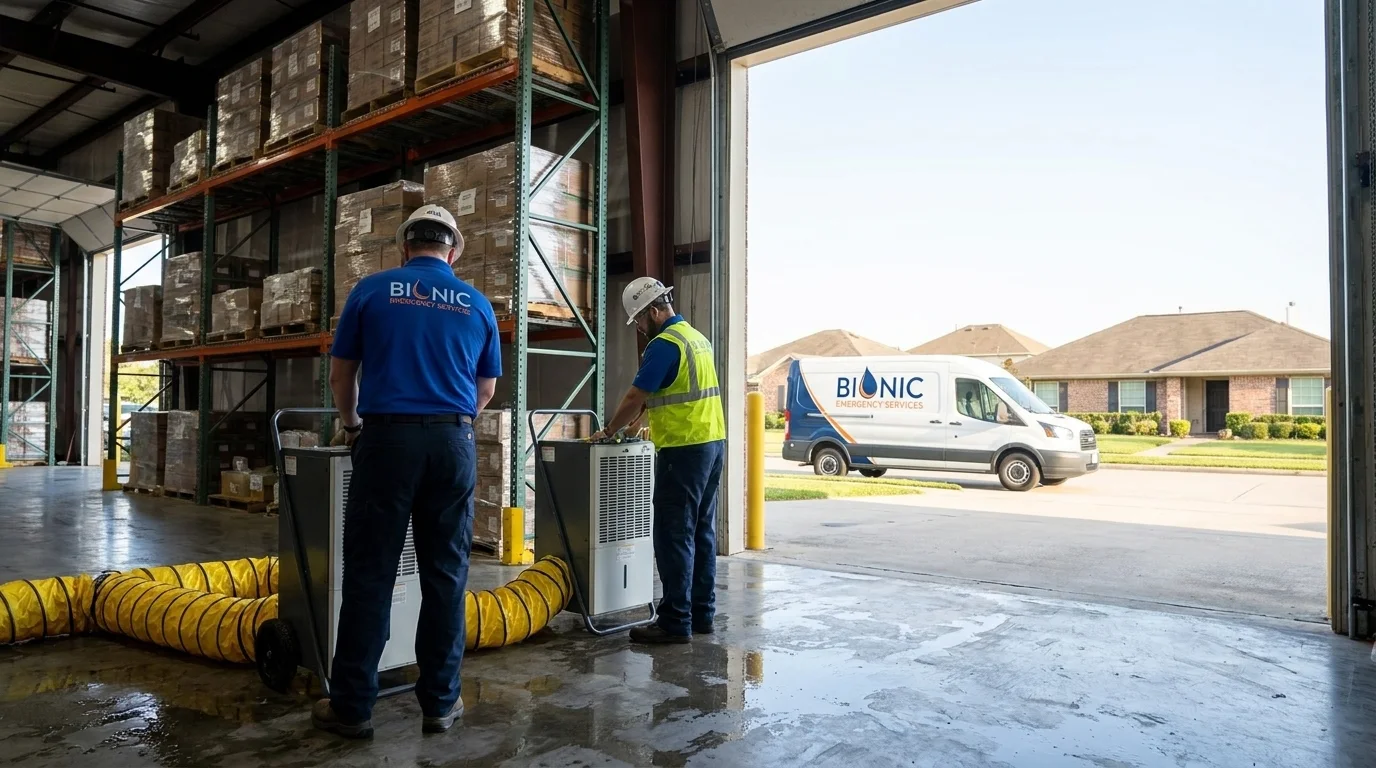
Industrial Restoration in Houston
24/7 industrial restoration in Houston and surrounding areas. IICRC-trained technicians, insurance billing accepted. Call (713) 338-2424.
Water pooling under a pallet rack system or smoke rolling through a production line doesn’t wait for a convenient time. When a cooling tower overflows, a sprinkler head fails above a server room, or a fire breaks out near a loading dock, the damage spreads through concrete, steel, and process equipment differently than it does through a house. BIONIC Emergency Services answers 24/7 for industrial restoration in Houston, bringing IICRC-trained technicians to warehouses, manufacturing plants, and distribution centers where downtime costs more per hour than most residential jobs cost in total.
What industrial restoration actually involves
Industrial restoration covers water and fire damage mitigation inside facilities built for production, storage, or distribution rather than daily living. That means large open floor plans, high-bay ceilings, exposed structural steel, concrete slab-on-grade flooring, and equipment that can’t simply be moved out of the way. A warehouse flood from a burst fire-suppression line behaves differently than a residential leak: water travels fast across wide, flat concrete, pools under racking, and finds its way into electrical trenches and equipment pits before anyone notices the puddle.
Fire and smoke in a manufacturing setting bring their own complications. Synthetic materials, machine lubricants, and stored inventory can produce dense, corrosive soot that attacks metal surfaces within hours, not days. Equipment packed with circuit boards and sensors is especially vulnerable to smoke residue, which is acidic and will continue to corrode exposed metal long after the fire is out if it isn’t addressed quickly. Plant restoration work typically runs on compressed timelines because every day a production line sits idle is a day of lost output, so scope, documentation, and drying or soot removal all move in parallel rather than one step at a time.
Our process
- Facility assessment and hazard check. Before any equipment or technician enters an affected area, we identify electrical hazards, structural concerns, and any areas that need to be isolated from ongoing plant operations.
- Moisture mapping or soot characterization. For water losses, we use moisture meters and thermal imaging to track water migration across slab, under equipment pads, and into wall cavities. For fire losses, we identify whether soot is dry/protein-based or wet/synthetic, since the cleaning approach differs for each.
- Targeted extraction or containment. Industrial water removal often means pumping standing water from pits, trenches, and low points across a large footprint, not just running a wet vac in one room. Fire-damaged zones get contained to keep soot and odor from migrating into unaffected production areas.
- Structural drying with monitoring, or soot and odor treatment. Commercial-grade dehumidifiers and air movers are placed based on the moisture map, and we track readings daily until materials reach dry standard. On the fire side, this is where thermal fogging and surface cleaning happen on affected equipment, ductwork, and structural steel.
- Documentation and sign-off. Every stage gets photographed and logged, because industrial claims involve larger dollar amounts and more scrutiny from carriers and facility insurers than a typical homeowner claim.
What separates a good industrial restoration response from a bad one
The biggest mistake in warehouse and plant losses is treating them like oversized residential jobs. A crew that shows up with household equipment and no plan for the facility’s electrical panels, process lines, or racking systems will miss water that’s traveled fifty feet from the source or soot that’s settled inside equipment housings. Adjusters reviewing industrial claims look for clear moisture mapping data, drying logs tied to IICRC S500 standards, and photo documentation that shows the full extent of the affected footprint, not just the obvious wet spots.
Another common gap is sequencing. Facilities often need partial areas returned to operation while restoration continues elsewhere, and that requires containment barriers and air management that keep moisture or soot from migrating back into cleared zones. Good operators coordinate with facility managers on which lines or areas are priority, and they document decisions so there’s no dispute later about what was dried first and why.
What does industrial restoration cost?
Industrial losses vary enormously based on square footage, the type of materials or inventory affected, and whether production equipment is involved. These are typical industry ranges, not a quote, and most facility insurance policies cover water and fire damage mitigation, though coverage for inventory loss, business interruption, and equipment repair depends on the specific policy. BIONIC Emergency Services provides a written scope of work before any work begins so facility managers know exactly what’s being done and why.
| Scenario | Typical range |
|---|---|
| Small warehouse section, clean water, under 2,000 sq ft | $3,500 - $9,000 |
| Large warehouse, standing water across racking footprint | $15,000 - $45,000 |
| Manufacturing floor, water affecting equipment pits | $20,000 - $60,000+ |
| Contained fire/smoke damage, single production zone | $10,000 - $30,000 |
| Facility-wide smoke and soot remediation | $40,000 - $150,000+ |
Seasonal & regional considerations
Houston’s humidity means any standing water in a warehouse or plant that isn’t dried quickly becomes a secondary damage risk within 24 to 48 hours, especially in enclosed mezzanines or equipment rooms with limited airflow. Hurricane season brings storm surge and heavy rain risk for facilities near the Ship Channel and other low-lying industrial corridors, where flood water entering a building often carries contaminants that require a different cleanup protocol than a clean-water pipe break. Older industrial buildings around Houston’s established manufacturing districts also tend to have aging roof systems and slab penetrations that are worth a proactive look before the next storm, not just after one.
Service area
BIONIC Emergency Services responds to industrial and commercial facilities throughout Houston and the surrounding area, including communities along the major industrial corridors and nearby suburbs where distribution centers and manufacturing plants are concentrated.
If water is spreading across your facility floor or smoke has reached your equipment, call (713) 338-2424 to get an industrial restoration crew assessing the damage and building your scope of work.
Frequently Asked Questions
Does commercial or industrial property insurance cover water and fire damage restoration?
How is industrial water damage different from a typical residential water loss?
Can part of our facility keep operating while restoration work is happening?
What's the difference between protein-based and synthetic soot in a plant fire?
Looking for the best industrial restoration company in Houston?
BIONIC Emergency Services provides industrial restoration in Houston, TX and the surrounding area, and has served local property owners since 2011. Customers rate us 4.9 out of 5 stars across 154 Google reviews. We answer calls 24/7 — call (713) 338-2424 for immediate help.
Need Industrial Restoration now?
We respond 24/7 across Houston and surrounding TX cities.