
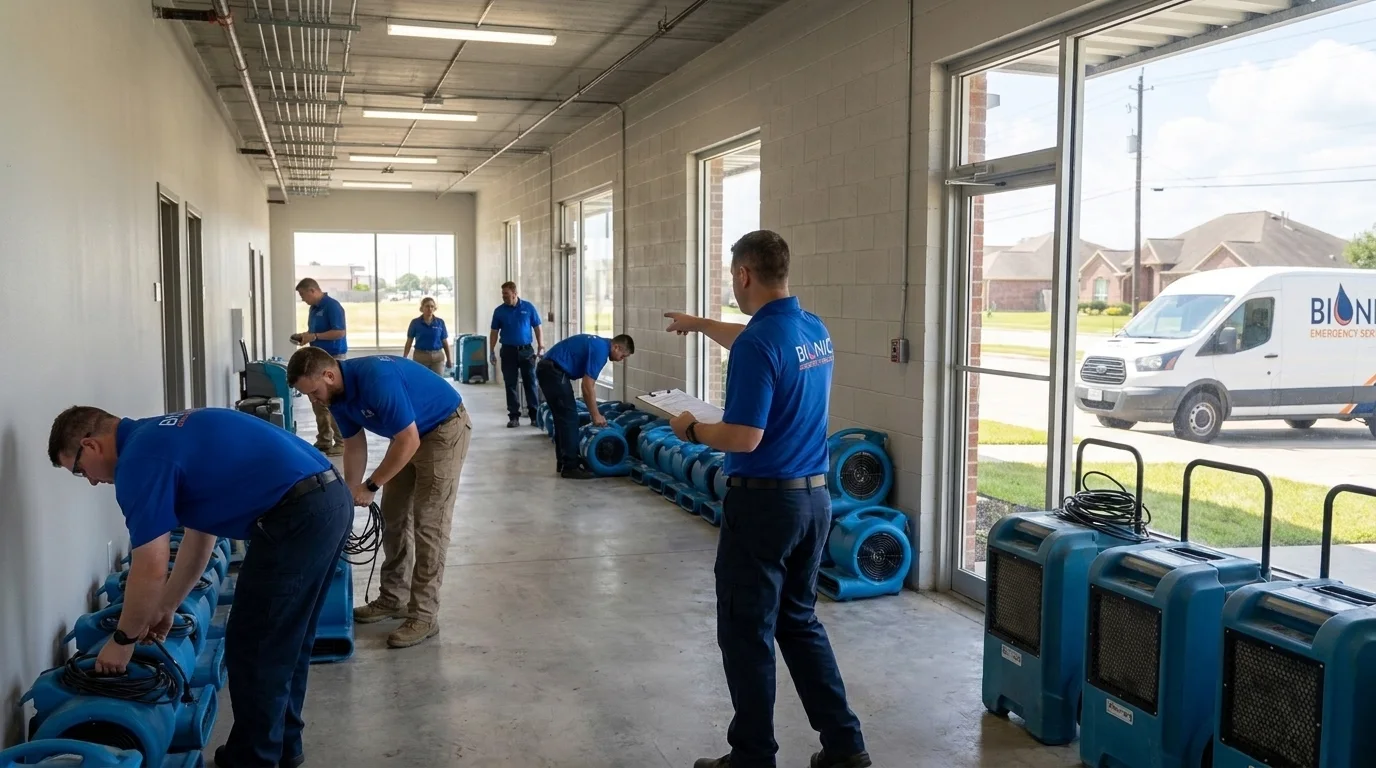
Large Loss and Catastrophic Response in Houston
24/7 large loss and catastrophic response in Houston and surrounding areas. IICRC-trained technicians, insurance billing accepted. Call (713) 338-2424.
When a loss hits more than one unit, more than one floor, or more than one building at once, the math changes. A single water extraction crew with a few air movers cannot keep pace with a flooded 200-unit apartment complex, a hotel with simultaneous fire and water damage, or a manufacturing floor where downtime costs more per day than the repair itself. Large loss and catastrophic response in Houston means mobilizing multiple crews, heavy equipment, and a single point of project oversight from the first walkthrough through the final certificate of completion.
What Large Loss and Catastrophic Response Actually Involves
A large loss is generally defined by scale and complexity rather than a single dollar figure: multi-building apartment or condo communities, hotels, hospitals, schools, manufacturing and distribution facilities, or any property where the loss affects multiple systems (structural, electrical, HVAC, life safety) at the same time. Catastrophic loss response adds a layer of urgency, usually tied to a named storm, widespread flooding, or a regional event that pulls crews and materials from across the Gulf Coast into short supply simultaneously.
The work itself scales up everything a standard residential job does. Instead of one moisture meter and a handful of air movers, a large loss site runs continuous moisture mapping across dozens of rooms or units, desiccant dehumidification sized for tens of thousands of cubic feet, and a logistics plan for staging equipment, generators, and waste removal on a property that may still be partially occupied. Our IICRC-trained technicians apply the same S500 drying standards used on a single-family home, just at a scale that requires coordinated scheduling across multiple crews working in parallel rather than in sequence.
Our Process
- Rapid site assessment and loss mapping. Before equipment moves in, we walk the full affected footprint, documenting every impacted unit, floor, or system so the scope is built on what is actually damaged, not an estimate from the street.
- Crew and equipment mobilization. Large loss jobs are staffed differently than a single-room water call. We scale the crew count and equipment inventory (extraction units, desiccant dehumidifiers, air scrubbers) to the square footage and category of loss, not the other way around.
- Phased extraction and structural drying. Multi-building or multi-unit properties rarely dry in one pass. We sequence extraction and drying by priority, starting with life-safety systems, occupied units, and areas at highest risk of secondary damage.
- Continuous moisture monitoring and documentation. On a job this size, the paper trail matters as much as the drying. We log moisture readings, equipment placement, and daily progress across every affected area so the file holds up under adjuster review.
- Coordination with ownership, property management, and adjusters. A catastrophic loss usually involves more than one decision-maker. We keep property managers, large loss adjusters, and ownership groups aligned on scope and timeline so the project doesn’t stall waiting on approvals.
What Separates a Good Large Loss Response From a Bad One
The most common failure on a catastrophic loss isn’t bad drying technique, it’s bad sequencing. Crews that treat a 150-unit complex like fifteen separate single-unit jobs lose time re-staging equipment, miss moisture migrating between shared walls and corridors, and create documentation gaps that slow claim payment. A commercial catastrophic restoration done right treats the property as one interconnected system: shared HVAC runs, common-area plumbing, and party walls all get mapped before drying begins, not discovered mid-job.
Large loss adjusters are also looking for specific things in the file: consistent daily moisture logs, clear photo documentation tied to each affected area, and a scope that was written before demolition started rather than reverse-engineered after the fact. Properties that skip pre-loss documentation or let drying equipment run unmonitored for days at a time tend to see claims drag out, because there’s no data to support what was actually done. A written scope of work before mobilization, and daily tracking throughout, is what keeps a multi-million dollar restoration moving instead of stalling in review.
What Does Large Loss and Catastrophic Response Cost?
Costs on large loss work vary more than almost any other restoration category, since the number of affected units, the category of water or extent of fire damage, and the condition of building systems all drive the final figure. These are typical industry ranges, not a quote; every loss gets a written scope before any work begins, and most commercial property and master insurance policies cover sudden, accidental damage, though coverage for business interruption and code upgrades varies by policy.
| Scenario | Typical range |
|---|---|
| Single commercial unit, water intrusion | $8,000 - $25,000 |
| Multi-unit apartment building, partial flooding | $75,000 - $300,000 |
| Hotel or multi-floor property, combined fire and water | $250,000 - $1,000,000+ |
| Manufacturing or warehouse floor, equipment and structure | $150,000 - $750,000 |
| Regional storm event, multi-building portfolio | $1,000,000 - $5,000,000+ |
Seasonal & Regional Considerations
Houston’s hurricane season runs roughly June through November, and it’s the period most likely to generate the kind of widespread, multi-property damage that defines a catastrophic loss: storm surge pushing into ground-floor commercial space, straight-line winds tearing roof systems off warehouses, and street flooding that backs up into parking garages and basements across several blocks at once. Outside of named storms, the region’s flat terrain, high water table, and clay-heavy soil mean a single heavy rain event can affect an entire business park or apartment corridor simultaneously, which is exactly the scenario large loss response is built for.
Service Area
BIONIC Emergency Services handles large loss and catastrophic response throughout Houston and the surrounding area, including commercial and multi-family properties across the broader Gulf Coast region.
If your property is facing a loss that spans multiple units, floors, or buildings, don’t wait for the scope to grow. Call (713) 338-2424 to request a large loss site assessment and get a crew structure built for the actual size of the damage.
Frequently Asked Questions
Does commercial property insurance cover large loss and catastrophic restoration?
How is a large loss job staffed differently than a standard residential water or fire call?
What qualifies a loss as 'large loss' versus a standard residential claim?
How do you sequence drying and extraction across a multi-building or multi-unit property?
What documentation do large loss adjusters typically require before approving a claim?
Looking for the best large loss and catastrophic response company in Houston?
BIONIC Emergency Services provides large loss and catastrophic response in Houston, TX and the surrounding area, and has served local property owners since 2011. Customers rate us 4.9 out of 5 stars across 154 Google reviews. We answer calls 24/7 — call (713) 338-2424 for immediate help.
Need Large Loss and Catastrophic Response now?
We respond 24/7 across Houston and surrounding TX cities.