
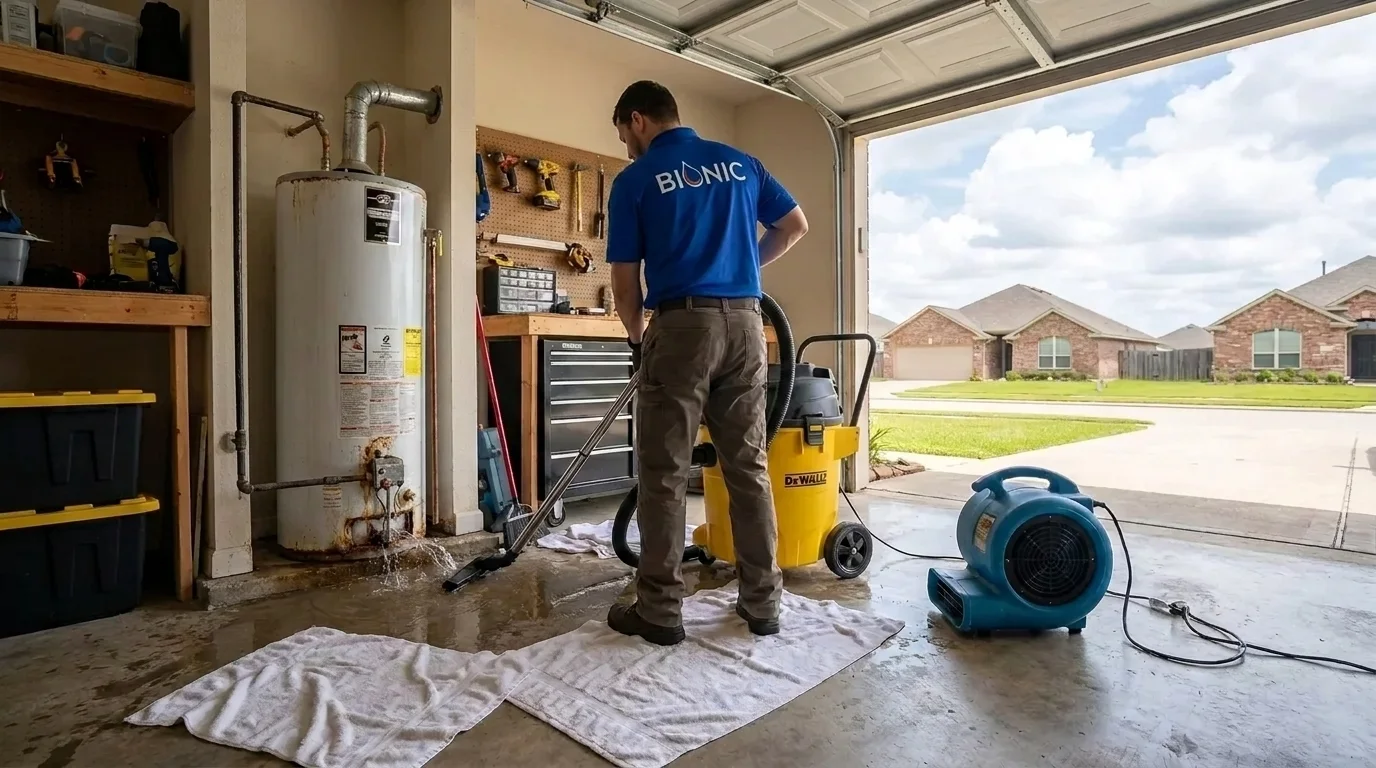
24/7 Emergency Water Heater Flood Cleanup in Houston
24/7 emergency water heater flood cleanup in Houston and surrounding areas. IICRC-trained technicians, insurance billing accepted. Call (713) 338-2424.
Water heater flooding your utility closet, garage, or attic? Call now for emergency service before the water finds its way into drywall, subflooring, or the unit below. A failed water heater can empty 30 to 50 gallons in minutes, and if the tank itself has ruptured rather than just the supply line, that water keeps coming until someone shuts off the cold water valve feeding it.
A water heater leak rarely stays contained to where the unit sits. Water finds the lowest point, tracks along slab seams, and wicks up into baseboards and cabinet toe-kicks long before a homeowner notices a stain. If the water heater sits in an attic or a second-floor closet, as it does in many newer Houston builds, gravity turns a small leak into a ceiling collapse somewhere else in the house entirely.
What water heater flood cleanup actually involves
This isn’t a mop-and-fan job. A leaking or burst water heater is typically a Category 1 (clean) water loss if caught early, but it reclassifies to Category 2 once the water sits for more than 24 to 48 hours or picks up contaminants from flooring adhesives, pet areas, or garage storage. The work starts with locating and shutting off the source, then extracting standing water with truck-mount or portable extraction equipment before it migrates further into wall cavities. Flooring is checked for water pooling underneath, baseboards are pulled where needed to let wall cavities dry, and affected drywall, insulation, and subfloor are assessed for whether they can dry in place or need to come out. Commercial air movers and dehumidifiers run until moisture readings in studs, subfloor, and drywall return to a dry standard, which for a contained residential leak is usually a matter of days, not weeks.
Our process
- Source shutoff and safety check. Confirm the water supply to the unit is off, check for electrical hazards if the heater is electric, and assess whether gas supply needs to be addressed for a gas unit.
- Water extraction. Remove standing water from flooring, inside cabinets, and from the water heater closet or pan itself using extraction equipment matched to the volume involved.
- Moisture mapping. Use moisture meters and thermal imaging to find where water traveled under flooring, behind baseboards, and into adjoining rooms, not just where it’s visible.
- Structural drying. Set air movers and dehumidifiers per IICRC drying standards, with daily moisture monitoring until materials hit dry standard. Cat 2 water from aged units or longer-standing leaks gets antimicrobial treatment on affected materials.
- Documentation for the claim. Photograph the source, the affected materials, and moisture readings at each visit so the scope of work matches what the insurance adjuster needs to see.
What separates a good water heater flood cleanup response from a bad one
The most common miss is drying the visible flooring and calling it done while the wall cavity behind the baseboard, or the subfloor under vinyl plank, stays wet. Vinyl plank and laminate in particular can look dry on the surface while trapping moisture underneath, which is exactly the kind of thing that turns into a moisture problem three weeks later. A thorough response pulls baseboards or drills small inspection holes where moisture readings say it’s needed, rather than guessing from the surface.
Adjusters also look for documented moisture readings over multiple visits, not a single day’s numbers. If a water heater sat leaking for an unknown period before discovery, that history matters for whether the loss is treated as Category 1 or 2, which affects both the scope of remediation and how the claim is written. Replacing the water heater itself is a job for a licensed plumber; BIONIC Emergency Services handles the water damage and structural drying side and can point you to that specialist when the unit itself needs repair or replacement.
What does water heater flood cleanup cost?
Costs depend heavily on how long the water sat before discovery and how far it traveled. A leak caught within hours in a dedicated closet costs far less to remediate than a tank burst in an attic that soaked a ceiling below. Every loss gets a written scope of work before anything starts, and most homeowners insurance policies cover sudden water heater failures (though not the cost of replacing the worn-out unit itself, which is typically treated as normal wear).
| Scenario | Typical range |
|---|---|
| Small leak caught early, minimal water intrusion | $400 - $1,200 |
| Tank burst, contained to water heater closet | $800 - $2,500 |
| Tank burst with water spreading to adjacent flooring or drywall | $2,000 - $6,000 |
| Water heater in attic with ceiling or drywall collapse | $4,000 - $12,000 |
| Water heater in garage or finished space with contents damage | $3,000 - $9,000 |
Seasonal & regional considerations
Houston’s humidity works against fast drying even in a well-contained loss. Houston homes also commonly sit on slab foundations, so water from a ground-floor water heater has nowhere to go but out under walls and cabinets instead of down, which means moisture mapping across flooring and lower walls matters more here than it would in a home with a basement.
Service area
BIONIC Emergency Services responds to water heater flood cleanup calls throughout Houston and the surrounding communities. If you’re outside the immediate area, mention your city when you call and we’ll confirm coverage.
If your water heater is leaking or has already burst, shut off the supply line if it’s safe to reach and call (713) 338-2424 to schedule your moisture assessment before the water spreads further than you can see.
Services We Handle
- Appliance Leak Cleanup
Frequently Asked Questions
Does homeowners insurance cover water heater flood cleanup?
How fast does water from a burst water heater spread under flooring?
What's the difference between cleaning up a slow leak versus a tank burst?
Will you repair or replace the water heater itself?
Looking for the best water heater flood cleanup company in Houston?
BIONIC Emergency Services provides water heater flood cleanup in Houston, TX and the surrounding area, and has served local property owners since 2011. Customers rate us 4.9 out of 5 stars across 154 Google reviews. We answer calls 24/7 — call (713) 338-2424 for immediate help.
Need Water Heater Flood Cleanup now?
We respond 24/7 across Houston and surrounding TX cities.