
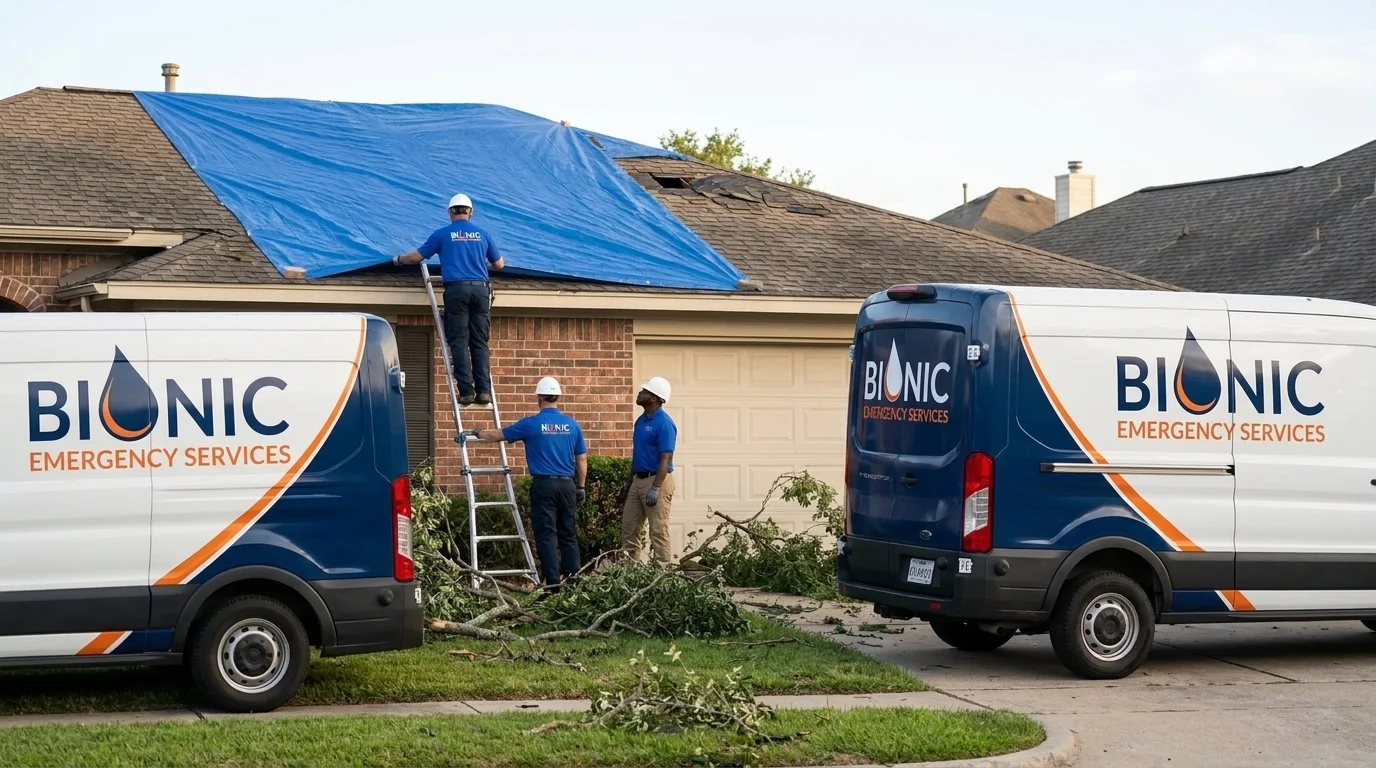
24/7 Emergency Storm Damage Restoration in Baytown
24/7 emergency storm damage restoration in Baytown, TX. IICRC-trained technicians, insurance billing accepted. Call (713) 338-2424.
Our IICRC-certified technicians are dispatched from our Houston, TX headquarters and are typically on-site in Baytown within 60 minutes of your call.
When a tropical system pushes through the upper Texas coast, Baytown’s low-lying bayfront neighborhoods near Goose Creek and Galveston Bay take the brunt of storm surge before the wind even finishes tearing at rooflines. Storm damage restoration here means working through saltwater intrusion, wind-driven roof failures, and downed trees across Harris County, sometimes all on the same property. BIONIC Emergency Services answers 24/7 when a storm has already moved through and water is still rising in the yard.
Why Baytown Sees Storm Damage That’s Different From Inland Houston
Baytown sits at the convergence of Galveston Bay, the Houston Ship Channel, and Cedar Bayou, which means tropical systems bring surge and bayou backflow on top of the usual wind and hail. Neighborhoods like Goose Creek and parts of Pelly sit close enough to the water that a Category 1 or even a strong tropical storm can push brackish water into yards and garages well before the eye makes landfall. Add in Baytown’s mature tree canopy, especially in older sections of Wooster and around the Texas Avenue historic district, and you get a predictable pattern after severe weather: downed limbs on roofs, fence lines flattened, and shingles peeled back from sustained coastal wind. The proximity to the ExxonMobil Baytown Refinery and the industrial corridor along the ship channel also means some properties deal with debris and runoff that’s different from a typical residential storm loss, which affects how we approach cleanup and disposal.
Our Storm Damage Restoration Process in Baytown
The first visit is about stopping further loss, not full repair. That means emergency tarping over compromised roof sections, board-up on blown-out windows or doors, and extraction of any standing water before it sits long enough to wick into drywall and insulation. From there we follow IICRC S500 drying protocols, using our WRT and ASD training to set moisture goals for framing, subfloor, and any salvageable finish materials rather than guessing at a timeline. Homes near the bay that took on brackish surge water get extra attention during drying, since salt residue left behind in wall cavities can continue attracting moisture long after the structure reads dry on the surface. Once materials are stabilized, we document everything with photos and moisture readings your adjuster will need.
Reaching Baytown from Houston
Most of our Baytown calls route in off I-10 East, with Route 146 and the Fred Hartman Bridge providing direct access to the bayfront side of town, including areas near the Baytown Nature Center and Pirates Bay Water Park. During active storms, we track bridge and roadway closures in real time since the Fred Hartman can close to high-profile vehicles in sustained wind, and we adjust routing to reach Goose Creek, Pelly, or Lee College-area addresses without delay.
Baytown Insurance & HOA Coordination
Storm claims in Baytown often split across two policies: wind and hail damage typically runs through a standard homeowner’s policy, while surge or bayou flooding usually falls under NFIP flood coverage or a separate flood rider. We’ve found that documenting the source of water, wind-driven rain versus rising surge, matters a great deal to how a claim gets paid out here, so we note entry points and water lines on walls as part of our initial assessment. For properties inside an HOA, particularly newer developments further from the historic core, we coordinate tarping and debris staging with property management to keep emergency work compliant with community standards while the claim is still open.
Local Note
In Pelly and Wooster, a number of homes were built before Baytown’s current elevation and drainage standards were in place, which means they tend to sit closer to original grade than newer construction near Lee College. After a surge event, we check crawlspace vents and perimeter grading first in these neighborhoods, since older foundations here hold ground moisture longer than slab homes built to more recent code. That extra moisture under the structure is often what turns a one-day dry-out into a multi-day job if it’s missed early.
If a storm has left standing water, a torn-open roof, or downed trees on your Baytown property, don’t wait on the damage to spread. BIONIC Emergency Services is available 24/7 for storm damage restoration across Baytown, from Goose Creek to the Texas Avenue historic district, and we can start stabilizing the property as soon as we arrive.
Serving Baytown from our Houston headquarters — ★ 4.9 · 154 Google reviews
“Very professional and proficient.” — Jasmine, August 2026Read our reviews on Google →
Storm Damage Restoration in Baytown: Service Coverage
Frequently Asked Questions
How fast can you arrive for storm damage restoration in Baytown?
How quickly can BIONIC reach Goose Creek or Pelly after a hurricane warning is lifted?
Does storm surge from Galveston Bay get handled differently than wind damage for insurance purposes in Baytown?
Are older homes in Wooster or the Texas Avenue historic district more vulnerable to storm damage?
What's your process for drying out a Baytown home after wind-driven rain gets behind the siding?
Do you coordinate storm damage claims for homeowners near ZIP 77520 who are close to the bay?
Storm Damage Restoration response in Baytown
Most Baytown calls see a technician on-site within 60 minutes from our Houston headquarters.
Nearby & Related
- 24/7 Emergency Storm Damage Restoration in Houston
- Restoration Services in Baytown
- 24/7 Emergency Fire Damage Restoration in Baytown
- 24/7 Emergency Water Damage Restoration in Baytown
- 24/7 Emergency Storm Damage Restoration in Katy
- 24/7 Emergency Storm Damage Restoration in Missouri City
- Contact BIONIC Emergency Services