
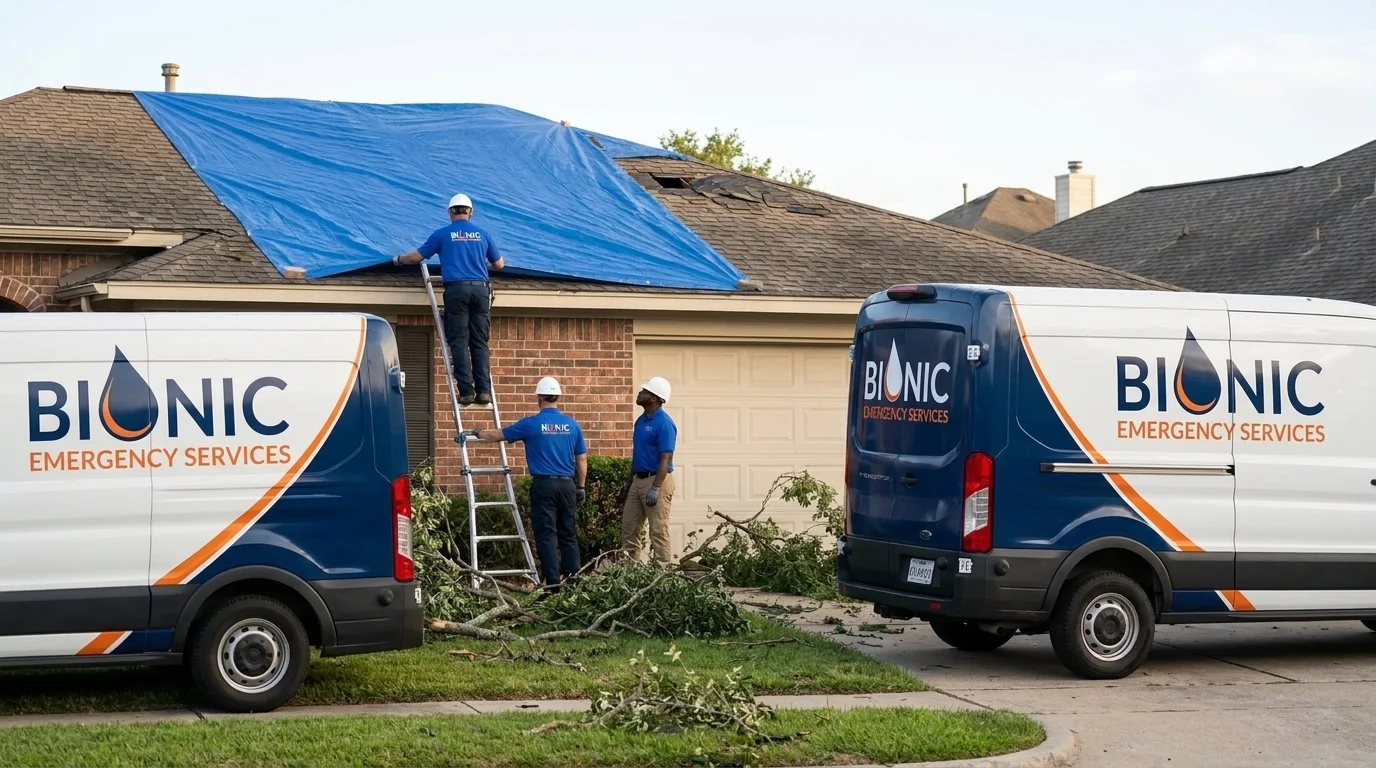
24/7 Emergency Storm Damage Restoration in Houston
24/7 emergency storm damage restoration in Houston and surrounding areas. IICRC-trained technicians, insurance billing accepted. Call (713) 338-2424.
Storm damage emergency in Houston? Call (713) 338-2424 now. We answer 24/7 because the gap between a storm passing and a tarp going up is exactly where a roof leak turns into a soaked attic, and a cracked window turns into warped flooring two rooms away. Wind-driven rain doesn’t need a hole in your roof to get in, it finds gaps around flashing, soffits, and window seals, and it keeps moving until something absorbs it.
What Storm Damage Restoration actually involves
Storm damage restoration covers the mitigation work that happens after wind, hail, hurricane bands, or a falling tree compromise a building’s exterior: emergency roof tarping and board-up, extraction of water that’s entered through the breach, removal of storm debris that’s trapping moisture against the structure, and structural drying once the opening is sealed. It’s distinct from a slow plumbing leak in one important way, the water source is still outside and often still active when we arrive, so the first hours are about stopping the intrusion, not just cleaning up what’s already happened. Depending on how much water got behind drywall, insulation, or subfloor, drying can run several days with moisture monitoring at each check-in.
Our process
- Emergency tarping or board-up. We cover the breach, whether that’s a missing section of roof decking, a shattered window, or a wall opened up by a fallen limb, to stop additional water from entering while the weather clears.
- Water and debris extraction. Standing water, saturated insulation, and storm debris come out first. Tree limbs and roofing material often need to be cleared before drying equipment can even be placed.
- Structural drying and moisture mapping. Our techs follow IICRC WRT and ASD guidance to map how far moisture traveled behind walls and under flooring, not just where it’s visible, and place equipment accordingly.
- Documentation and claim support. Every affected area gets photographed and moisture-logged before and during drying, which becomes the backbone of your insurance claim.
What separates a good storm damage response from a bad one
The mistakes that cost homeowners the most money happen in the first 48 hours. A tarp that’s stapled instead of properly battened down tears loose in the next gust and lets more water in than the original damage did. Crews that dry only the visible wet drywall and skip the wall cavity behind brick veneer leave moisture that shows up as rot and odor three weeks later. Adjusters pay close attention to cause-of-loss separation on storm claims, wind damage and flood damage are often covered differently, and documentation that doesn’t clearly distinguish wind-driven rain intrusion from rising floodwater can slow a claim down or get part of it denied. Good storm response means moisture readings at multiple depths, photos timestamped before any repair work starts, and a scope of work that matches what the adjuster will actually ask about.
What does Storm Damage Restoration cost?
Every storm loss is different, roof pitch, how long water had access before the tarp went up, and whether a tree is still resting on the structure all change the scope, so BIONIC provides a written scope before any work begins. Homeowners insurance typically covers sudden storm damage, wind, hail, and fallen trees, though flood-specific exclusions are common and worth checking with your carrier directly.
| Scenario | Typical range |
|---|---|
| Emergency roof tarp and board-up | $400 - $1,200 |
| Water extraction and drying, single room | $1,500 - $4,000 |
| Whole-house water intrusion from wind-driven rain | $5,000 - $15,000 |
| Tree damage removal and structural drying | $3,000 - $10,000 |
| Large-scale hurricane cleanup, multiple rooms | $10,000 - $30,000+ |
Seasonal & regional considerations
Houston’s hurricane season runs roughly June through November, and tropical systems moving off the Gulf can spin off tornadoes well inland of landfall, so wind damage and tree damage often show up together in the same storm event. Flat terrain and heavy clay soil across the region mean water doesn’t drain away from a damaged structure as fast as it would elsewhere, which is part of why extraction speed matters as much as the repair itself.
Service area
BIONIC Emergency Services responds to storm damage across Houston and the surrounding area.
If wind or a fallen tree has opened up your roof, walls, or windows, don’t wait on the weather to fully clear. Call (713) 338-2424 to get a tarp on the breach and start your storm damage assessment before secondary water damage sets in.
Services We Handle
- Hurricane Damage Restoration
Frequently Asked Questions
Does homeowners insurance cover storm damage restoration?
What's the difference between wind damage and flood damage for insurance purposes?
How soon after a storm should a roof be tarped?
Do you document tree damage for the insurance claim?
Is storm water treated differently than a plumbing leak during drying?
Looking for the best storm damage restoration company in Houston?
BIONIC Emergency Services provides storm damage restoration in Houston, TX and the surrounding area, and has served local property owners since 2011. Customers rate us 4.9 out of 5 stars across 154 Google reviews. We answer calls 24/7 — call (713) 338-2424 for immediate help.
Need Storm Damage Restoration now?
We respond 24/7 across Houston and surrounding TX cities.
Related Coverage
- Our Restoration Services
- Contact BIONIC Emergency Services
- 24/7 Emergency Storm Damage Restoration in Baytown
- 24/7 Emergency Storm Damage Restoration in Katy
- 24/7 Emergency Storm Damage Restoration in Missouri City
- 24/7 Emergency Storm Damage Restoration in Pasadena
- 24/7 Emergency Storm Damage Restoration in Pearland
- 24/7 Emergency Storm Damage Restoration in Sugar Land
- 24/7 Emergency Storm Damage Restoration in The Woodlands
- Storm Damage Insurance Claim Checklist (Use This Before You Call Your Insurer)
- Emergency Storm Damage Restoration in Cloverleaf
- Emergency Storm Damage Restoration in Deer Park
- Emergency Storm Damage Restoration in Galena Park
- Emergency Storm Damage Restoration in Humble