
TL;DR: Commercial water damage restoration in Houston typically costs $3,000 to $75,000 or more, driven mostly by affected square footage, water category, and how much of the space needs reconstruction. Mitigation (extraction, drying, cleanup) and reconstruction (drywall, flooring, ceiling grid) are usually billed and insured as separate phases. Most commercial property policies cover sudden water losses from a source inside the building, but flood water and sewer backup typically need separate endorsements.
If a sprinkler head let go over the weekend or a slab leak flooded your retail space off the Gulf Freeway, you’re probably staring at an adjuster’s email asking for a scope and a number. Commercial water losses in Houston span a wide range: a single office suite with a contained leak costs far less than a warehouse floor with standing water across it. The final bill depends on how much square footage got wet, what kind of water it was, and how much of the building has to come apart before it goes back together. Here’s how that number actually gets built.
How Much Does Commercial Water Damage Restoration Cost in Houston?
Commercial water damage restoration in Houston typically runs $3,000 to $8,000 for a single office suite under 1,000 square feet with clean water, $8,000 to $25,000 for a mid-size office or retail space, and $25,000 to $75,000 or more for warehouses, multi-tenant buildings, or losses involving contaminated water and heavy reconstruction.
| Scenario | Typical Range |
|---|---|
| Small office suite, under 1,000 sq ft, Category 1 water | $3,000 - $8,000 |
| Mid-size office or retail, 1,000 - 5,000 sq ft | $8,000 - $25,000 |
| Large retail, restaurant, or multi-tenant space, 5,000+ sq ft | $25,000 - $60,000 |
| Warehouse or industrial floor with standing water | $35,000 - $75,000+ |
| Category 3 water (sewage or contaminated floodwater) | add 20% - 40% to the mitigation line |
| Reconstruction (drywall, flooring, ceiling grid, paint) | often 30% - 50% of total project cost |
These are industry-typical ranges, not a quote. Every commercial loss is different, and a commercial restoration crew should walk the space, log moisture readings, and hand over a written scope before any equipment gets plugged in. That document, not a phone estimate, is what your adjuster and your budget should be built around.
What Drives the Cost Up or Down?
Four things move a commercial water damage bill the most: how much square footage got wet, what category of water was involved, how many wall and ceiling cavities have to be opened, and how many days drying equipment sits on site running.
- Affected square footage. Cost scales with the footprint, but ceiling height matters too, warehouses and big-box retail with 16 to 20-foot ceilings need lift equipment and more air movement to dry upper wall cavities.
- Water category. Under the ANSI/IICRC S500 standard, Category 1 water (a clean supply line or sprinkler head) is the least expensive to remediate. Category 3 water, which includes sewage and any contaminated floodwater from the Ship Channel or a bayou overflow, requires antimicrobial treatment, PPE, and removal of porous materials like carpet and drywall rather than drying them in place.
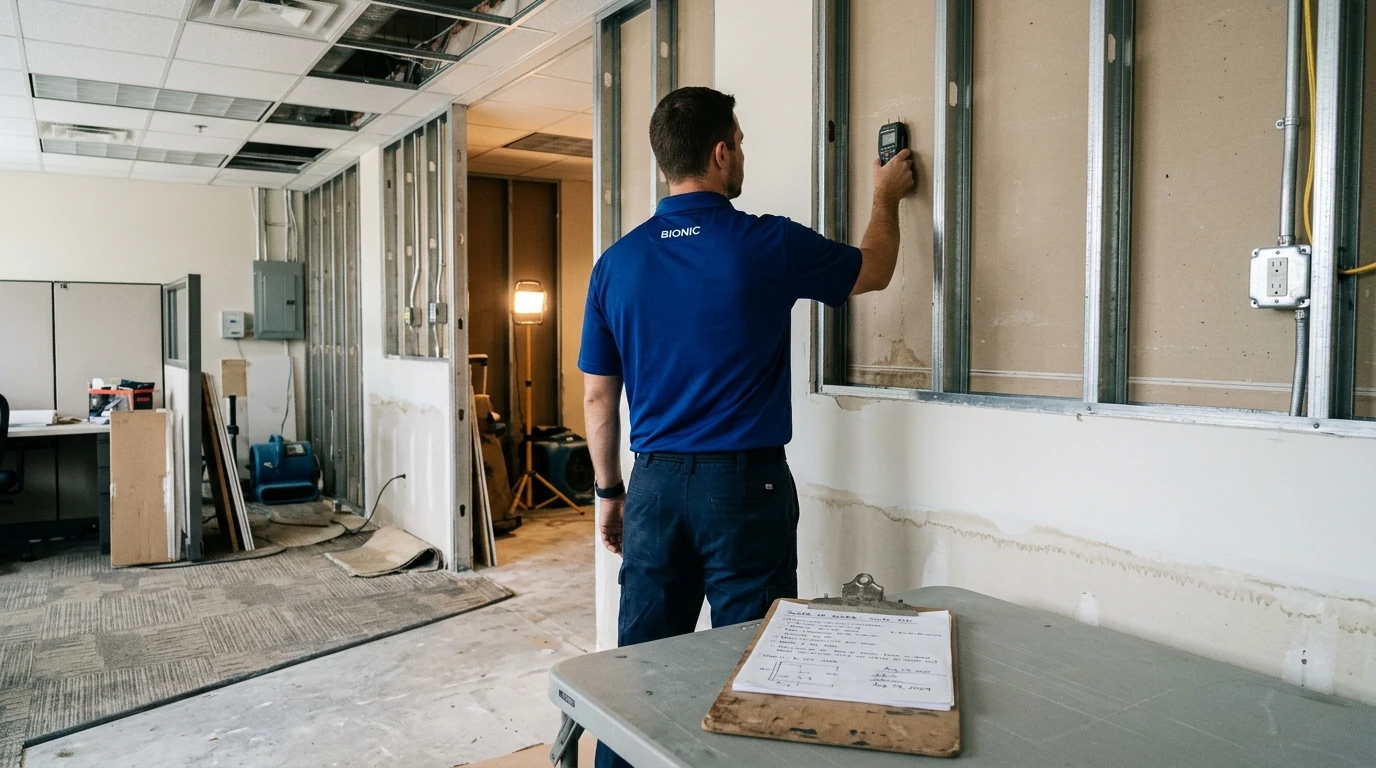
- Wall and ceiling cavities. Commercial buildings often have drop ceilings, metal stud cavities, and raised flooring that trap water out of sight. Moisture mapping with thermal imaging and penetrating meters adds labor hours before drying even starts.
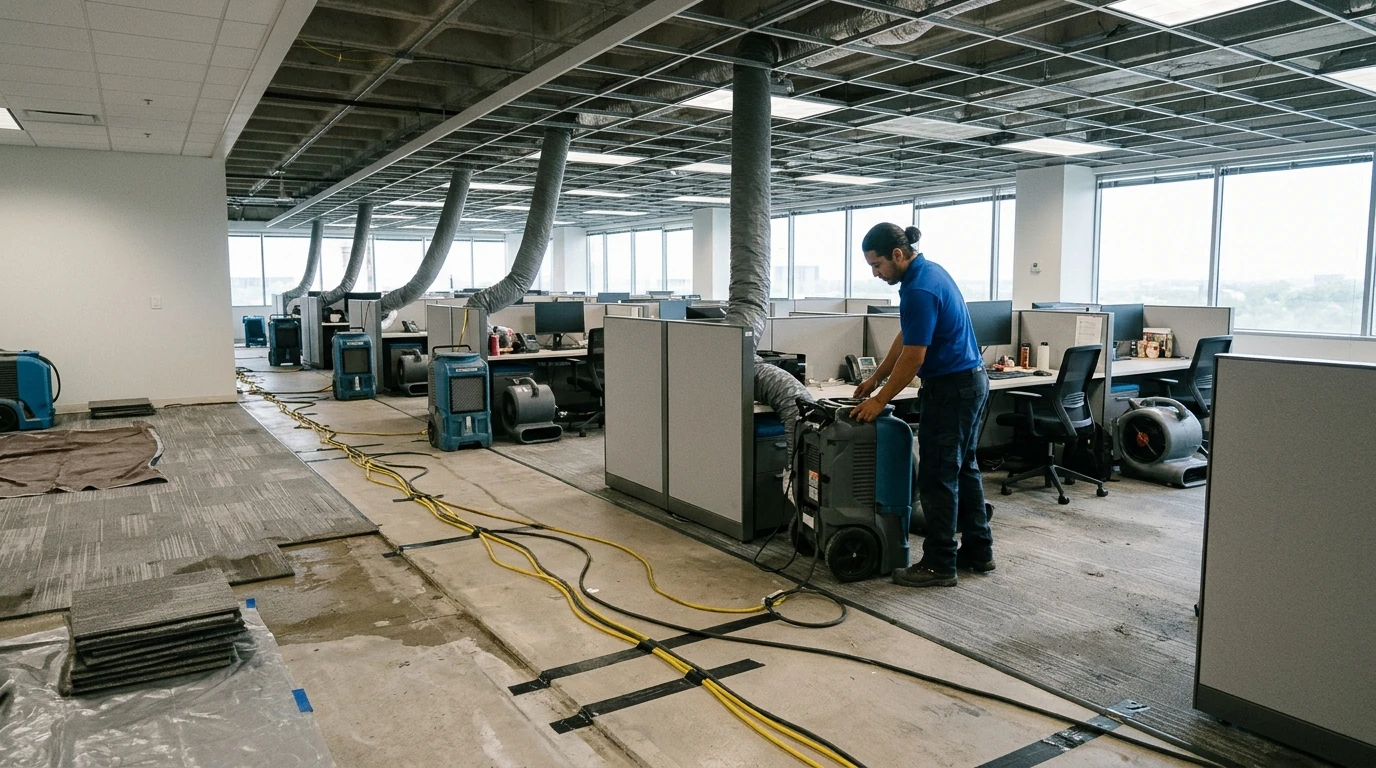
- Equipment days. Air movers and dehumidifiers are billed per unit, per day. A large open floor plan needs more units running longer than a single enclosed office.
- After-hours mobilization. A loss discovered at 9 p.m. on a Saturday costs more to respond to than one reported during business hours. If you’re counting on true 24/7 dispatch, confirm your restoration company offers it before you need it.
Does Commercial Insurance Cover Water Damage in Houston?
Most commercial property policies cover sudden, accidental water damage from a source inside the building, a burst supply line or a failed fire-suppression head, but flood water, sewer backup, and sump pump failure typically need separate endorsements added to the policy.
Texas businesses in flood-prone corridors, including much of the Houston area, often carry a commercial flood policy separate from their property policy for exactly this reason. The Texas Department of Insurance publishes consumer guidance on what standard policies do and don’t cover, and it’s worth a read before a loss, not after. Business interruption coverage, if purchased, is also a separate line item: it can reimburse lost income while the space is unusable, but carriers usually want financial records to support that number. See our post on protecting business continuity after a commercial water loss for what documentation to start gathering on day one.
What Does a Commercial Water Damage Insurance Claim in Houston Involve?
A commercial water damage claim generally moves through four steps: stop the source and document it, start mitigation immediately, log the drying process daily, and separate the mitigation invoice from the reconstruction bid.
- Shut off the water source and document the loss with photos and video before anything gets moved or thrown out.
- Call your insurance carrier and your restoration company at the same time. Most commercial policies include a duty to mitigate, waiting to “see what the adjuster says” can work against you if the damage spreads in the meantime.
- Get a written scope and daily moisture logs. Adjusters want to see documented drying progress, not just a final invoice with a total at the bottom.
- Keep mitigation and reconstruction as separate line items. Carriers often process these under different coverage provisions, and a contractor bid for rebuild work looks different from a mitigation company’s drying invoice.
Mitigation vs Reconstruction: Why the Line Matters
Mitigation and reconstruction are billed, scheduled, and usually insured differently, mitigation stops the ongoing damage and is almost always covered when the source was sudden, while reconstruction rebuilds what had to come out and may run into separate coverage limits.
Mitigation covers extraction, drying equipment, cleaning, and antimicrobial treatment where needed. Reconstruction covers drywall, flooring, ceiling grid, paint, and trim, essentially putting the space back the way it was. Keeping these as two scopes, rather than one bundled number, gives your adjuster a cleaner path to approve both and gives you a clearer picture of what’s recoverable under which part of the policy. For comparison, our Houston water damage restoration cost guide breaks down the residential version of this same math.
Who Should You Call First for Commercial Water Damage in Houston?
Call a restoration company with commercial experience before you call a general contractor, a mitigation crew can stabilize the loss and start the drying clock while the rebuild gets scoped separately.
Call BIONIC Emergency Services at (713) 338-2424 for a free evaluation. Technicians hold IICRC Water Damage Restoration Technician (WRT) and Applied Structural Drying (ASD) training, and the crew works commercial properties across Houston, Sugar Land, Pasadena, and the surrounding business corridors. Request the written scope before work begins, that document is what protects your claim and your budget.
About BIONIC Emergency Services
The company is a Houston-based restoration business founded in 2011, serving Greater Houston including Sugar Land, The Woodlands, Pearland, Baytown, and Katy. The crew handles water damage restoration, storm damage, sewage cleanup, fire and smoke damage, and contents restoration and storage, with technicians trained to IICRC WRT and ASD standards.