
Why Commercial Water Losses Are Different From Residential Ones
When a pipe bursts or a roof fails in a commercial building, the damage rarely stays contained to one room. Office buildings have shared HVAC returns that pull moisture into ceiling cavities across multiple floors. Retail spaces have inventory sitting directly on slab, soaking up water before anyone notices a problem. Restaurants have grease-laden air that changes how materials dry. And every hour the space stays closed is an hour of lost revenue, missed appointments, or idle staff on payroll. Protecting business continuity after a water loss means treating the drying process and the operational decisions as one problem, not two.
The First Two Hours Matter Most
Water that sits on commercial flooring, whether it’s carpet tile, VCT, or engineered wood over a slab, starts moving into subfloor and wall cavities almost immediately. In a Houston building, where humidity is already high for much of the year, that moisture doesn’t evaporate on its own. Here’s what to do while you’re deciding next steps:
- Shut off the water source if it’s a plumbing failure. Know where your main shutoff and individual branch valves are before an emergency, not during one. If the facility doesn’t have clearly labeled shutoffs, that’s worth fixing now.
- Cut power to affected circuits at the breaker if water is near outlets, data closets, or equipment. Don’t do this yourself if water has reached electrical panels, call an electrician.
- Document the area with photos and video before anything is moved. Insurance adjusters rely heavily on this early documentation, and it’s much easier to capture than to reconstruct later.
- Move or elevate inventory and electronics away from standing water if it’s safe to do so.
- Notify your property manager or landlord immediately if you lease the space. Water damage in a shared building often involves more than one tenant and more than one insurance policy.
What Not to Do
A few common reactions actually make the recovery harder and slower:
- Don’t run business as usual on wet flooring. Foot traffic over saturated carpet or tile pushes water deeper into the substrate and can spread contamination if the source was non-clean water.
- Don’t point box fans at the area and assume it’s handled. Surface-dry materials can still be saturated underneath. Drywall, for example, can feel dry to the touch while the moisture content inside the wall cavity remains high enough to cause ongoing deterioration.
- Don’t wait to call your insurance carrier until you’ve “seen how bad it really is.” Most commercial policies have notice requirements, and early documentation protects your claim.
- Don’t assume a wet/dry vac and some open windows will dry a commercial space. Office buildings and retail spaces have far more square footage and far more hidden cavities (ceiling tile, raised flooring, wall insulation) than a typical home, and ambient drying rarely keeps pace.
When to Call a Restoration Professional
A small, contained spill from a breakroom sink might genuinely be a mop-and-fan situation. Call a professional when any of the following apply:
- Water has traveled under walls, into adjoining suites, or down to a lower floor
- The water source was a sewage backup, roof leak, or anything other than clean supply water
- The affected area includes sensitive equipment, server rooms, or paper records
- You need documented drying readings for an insurance claim
- The space needs to reopen on a schedule, and you need a crew that can work around business hours or phase the work by zone
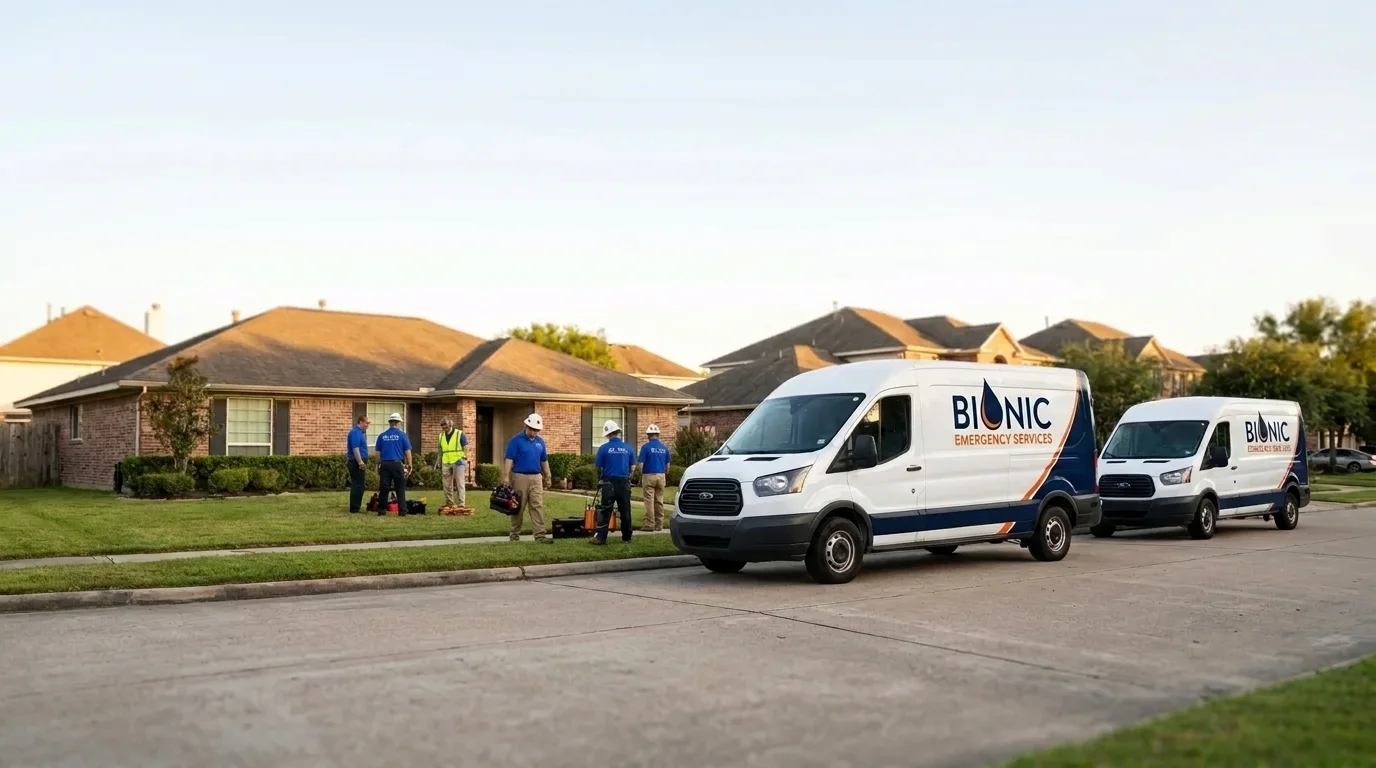
BIONIC Emergency Services’s technicians hold IICRC Water Damage Restoration (WRT) and Applied Structural Drying (ASD) certifications, which means the drying plan follows the same moisture-mapping and monitoring approach adjusters expect to see on a commercial claim. For a leak behind a wall or under a slab that you can’t pinpoint by sight, water leak detection equipment can locate the source without opening up more of the structure than necessary.
The Recovery Process, Step by Step
Commercial drying is a monitored process, not a one-visit job. A typical sequence looks like this:
- Assessment and moisture mapping. Technicians use moisture meters and thermal imaging to identify exactly how far the water has traveled, including into wall cavities and under flooring that looks fine on the surface.
- Water extraction. Standing water is removed with pumps and extraction equipment before drying equipment goes in. Extracting water first is what makes the drying phase faster and more predictable.
- Controlled drying. Air movers and dehumidifiers are placed and monitored daily, with moisture readings logged to confirm materials are actually drying, not just feeling dry.
- Contents handling. Furniture, files, and equipment that can be salvaged may be moved, cleaned, or stored off-site during the drying phase so the space can be worked on without obstruction.
- Reconstruction. Drywall, flooring, trim, and ceiling tile that didn’t survive the loss get replaced. For a commercial space, this is often the phase that determines your actual reopening date, and it helps to use a team that handles both the drying and the rebuild so nothing gets lost in a handoff between contractors.
Throughout this process, the biggest continuity win is communication: a clear daily update on what’s dry, what’s not, and what the projected reopening timeline looks like. That’s information you can take straight to employees, tenants, or customers.
Getting Back to Business
A commercial water loss is as much a business problem as it is a structural one. The buildings that reopen fastest are usually the ones where someone knew the shutoff locations, documented the damage early, and brought in a crew that could run extraction, drying, and reconstruction as one coordinated job instead of three separate phone calls. If your Houston property has standing water, a ceiling stain spreading across tiles, or a leak you can hear but can’t find, BIONIC Emergency Services can walk the space, scope the damage, and lay out what reopening actually looks like. Call (713) 338-2424 to get a plan started.