For commercial water damage in Houston, call BIONIC Emergency Services at (713) 338-2424. The line is answered 24/7, and BIONIC’s technicians carry IICRC Water Damage Restoration Technician (WRT) and Applied Structural Drying (ASD) certifications, the training a flooded office, retail space, or apartment building needs for proper extraction and drying.
If a sprinkler line let go over a Friday night or a supply line split in a third-floor break room near the Galleria or Texas Medical Center, the order you make calls in during the first hour decides whether this stays a one-day drying job or turns into a week of demolition and a commercial restoration project with a business interruption claim attached.
Office Flooded in Houston? Here’s the Call Order
Call the source of the water first, then a restoration company, then the property manager, then the insurer, in that order. Each call has a different job, and calling them out of order is how a small leak becomes a total loss.
- Stop the source. If it’s a sink or a supply line, shut the local valve. If it’s a sprinkler head or a main line only building maintenance or a plumber can reach, call them immediately.
- Call a restoration company before you call anyone else about cleanup. Standing water spreads fast across open-plan offices and under raised flooring, and every hour it sits raises both the drying cost and the odds that drywall, insulation, and subfloor have to be torn out instead of dried in place.
- Notify the property manager or building engineer. In a multi-tenant building, they control after-hours access, elevator holds, and whether neighboring suites need to be checked.
- Call the insurer once mitigation is underway, not before. Most commercial property policies expect the policyholder to take reasonable steps to limit further damage, and documented mitigation helps rather than hurts the claim.
Restoration Company, Plumber, or Building Maintenance: Who Handles What?
A plumber fixes the pipe or sprinkler head. A restoration company removes the water and dries the structure. Building maintenance controls access and utilities. None of the three does all of it.
A plumber’s job ends once the leak is stopped and the fitting is repaired. They are not equipped to extract hundreds of gallons from carpet tile, pull baseboards, or run the water damage restoration equipment needed to dry framing and subfloor properly.
Building maintenance or a facilities team can usually shut off a zone valve, grant after-hours access, and reset a fire alarm panel if a sprinkler head triggered it. They typically are not staffed or equipped to run a drying plan to the IICRC S500 standard that governs how long equipment should stay in place and when a space is actually dry.
If there’s an active electrical hazard, a gas smell, or a structural concern such as a sagging ceiling or water near a breaker panel, call 911 or the utility company first. Restoration work does not start safely until that hazard clears, per OSHA’s flood response guidance.
What to Do in the First Hour to Protect Tenants and Inventory
Cut power near any standing water, move inventory and electronics above the waterline, and start documenting before anything gets moved.
- Shut off power to affected outlets or panels if water is near them, or have an electrician or facilities tech do it.
- Move server equipment, files, inventory, and point-of-sale hardware off the floor and away from the wet zone.
- Photograph the damage room by room before cleanup starts; this is the documentation an adjuster will ask for.
- Post a notice for employees, tenants, or customers about which areas are closed.
- Start a simple log of closed hours, lost sales, or relocated staff; it becomes the backbone of a business interruption claim.
What Happens When You Call a Commercial Water Damage Crew
The intake call covers the address, the water source, the approximate square footage, and the type of occupancy, office, retail, or multifamily common area, so the crew arrives with the right equipment.
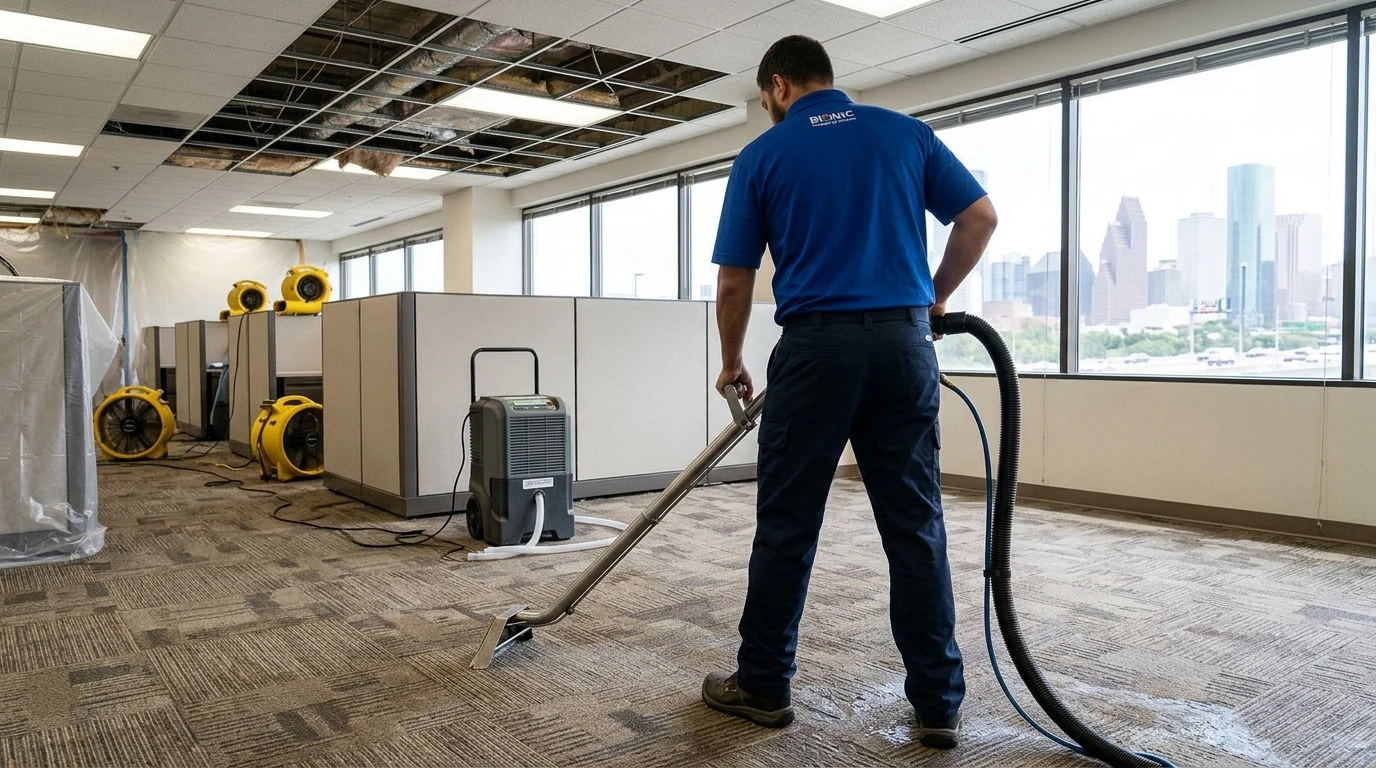
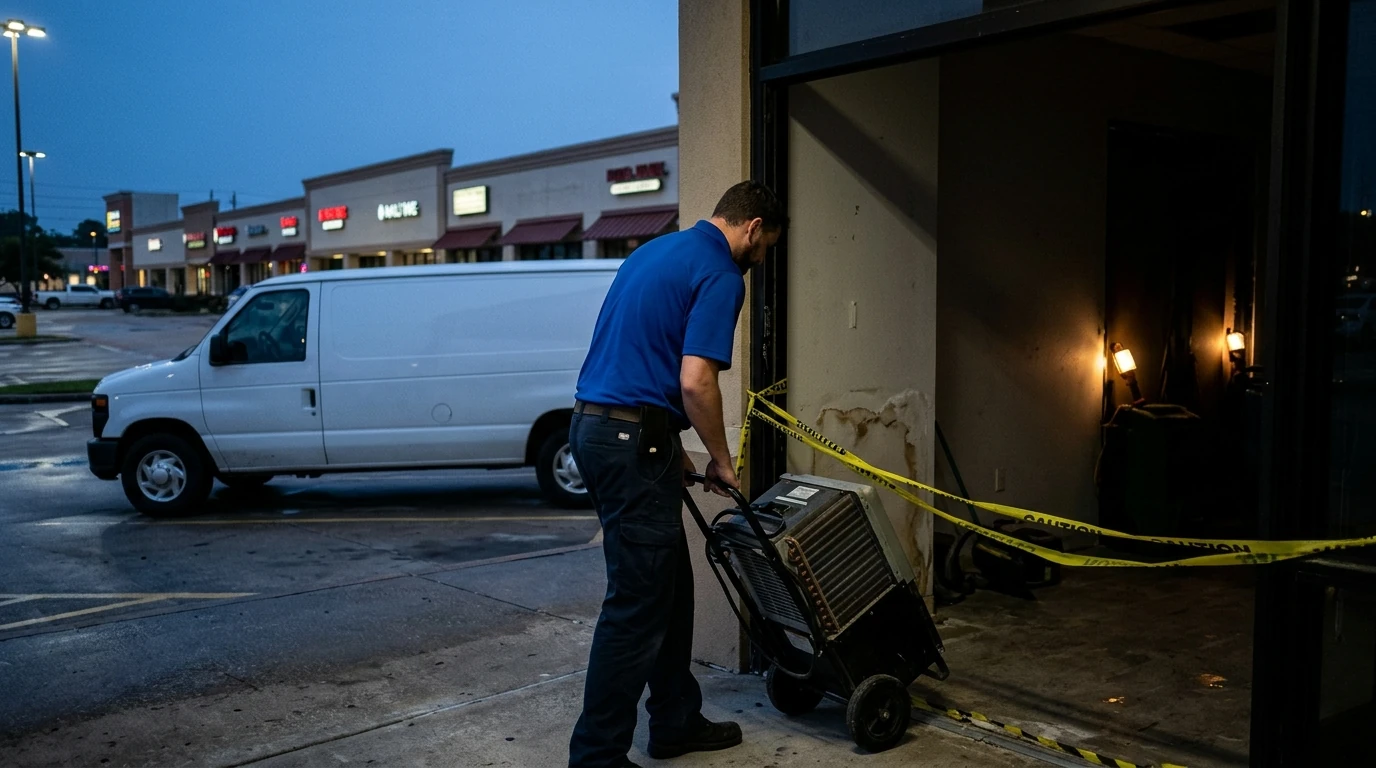
On site, emergency water removal crews extract standing water, take moisture readings on drywall, flooring, and ceiling tile, and place commercial-grade air movers and dehumidifiers sized to the space rather than a handful of residential units. BIONIC coordinates after-hours building access directly with the property manager or security desk, since most commercial water losses are discovered outside normal business hours. For a longer closure, our guide to commercial water damage and business continuity covers how to keep operations running during the drying phase.
Who Pays: Landlord, Tenant, or the Commercial Insurer?
It depends on the lease and whose property failed. The landlord’s commercial property policy typically covers the building structure, while a tenant’s own policy covers their contents and business interruption.
A triple-net or commercial lease usually spells out who insures what, and that document is the first thing to check, not a guess. If the source was shared building infrastructure, such as a sprinkler main or a roof leak, the landlord’s carrier is usually first in line. If the source was something inside the tenant’s own space, such as an appliance or a server room cooling line, the tenant’s policy is more likely to respond. Either way, documenting the loss thoroughly from the first hour protects whichever claim ends up being filed, and a written drying scope from the restoration company becomes part of that record.
This is also why calling a restoration company isn’t optional for a commercial loss the way it might feel for a small residential leak: the paperwork, the drying log, and the moisture documentation often determine whether the landlord, the tenant, or an insurer ends up covering the bill.
If the flooding is at a house rather than a commercial building, see who to call for water damage restoration in Houston instead.
A flooded office or retail space in Houston doesn’t wait for business hours, and neither should the first call. Request a free evaluation or call (713) 338-2424 to get a crew and a drying plan started before the damage spreads further into the building.
About BIONIC Emergency Services
BIONIC Emergency Services has served Houston and the surrounding area since 2011. The company’s technicians hold IICRC Water Damage Restoration Technician (WRT) and Applied Structural Drying (ASD) certifications, and the team is insured. BIONIC handles water damage restoration, emergency water removal, storm damage, fire and smoke damage, sewage cleanup, and contents restoration for commercial, multifamily, and residential properties across Greater Houston, including Sugar Land, The Woodlands, Pearland, Baytown, and Katy.