
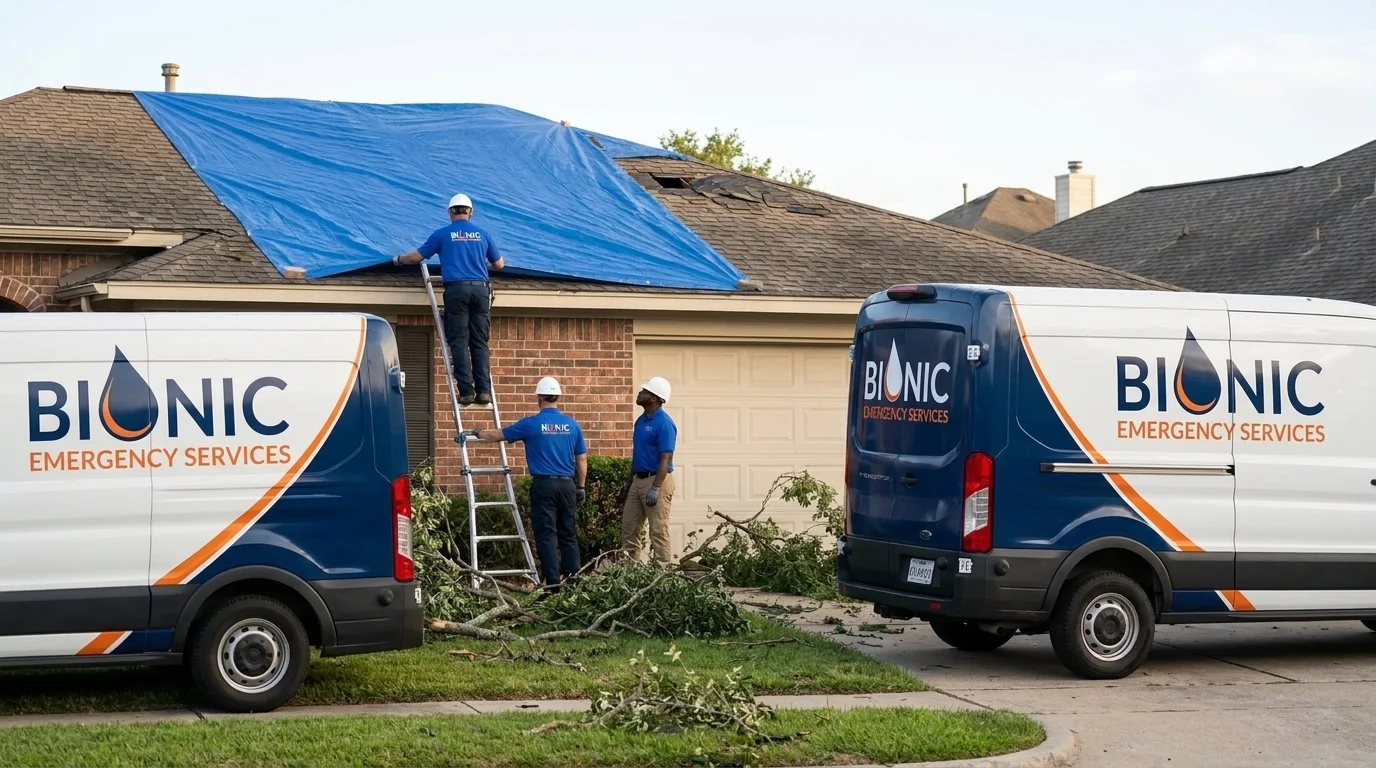
24/7 Emergency Storm Damage Restoration in Pasadena
24/7 emergency storm damage restoration in Pasadena, TX. IICRC-trained technicians, insurance billing accepted. Call (713) 338-2424.
Our IICRC-certified technicians are dispatched from our Houston, TX headquarters and are typically on-site in Pasadena within 60 minutes of your call.
Storm damage emergency in Pasadena? We answer 24/7 and send a crew out to assess roof, water, and tree damage before secondary issues set in. Gulf storms moving up the Houston Ship Channel can dump several inches of rain in under an hour, and that water doesn’t always stay outside. Along the Spencer Highway corridor and Red Bluff, older slab homes sit low enough that wind-driven rain and storm surge backup find their way under doors and through roof penetrations fast. Once a storm passes, the clock on drying out a structure starts immediately, whether the damage came from wind, hail, or a tree limb through the roof.
Why Pasadena Properties See Storm Damage Issues
Pasadena sits close enough to Galveston Bay and the Ship Channel that tropical systems and strong thunderstorm lines arrive with little warning. Flat clay soil across the area doesn’t drain quickly, so streets near Fairmont Parkway and the lower sections of Red Bluff can hold standing water long after the rain stops, and that water finds any gap in a slab foundation or a weep hole that’s been painted over. Mature oak and pecan trees common in older Pasadena yards, especially around Downtown Pasadena, lose limbs or topple entirely in straight-line winds, taking roof decking, gutters, and sometimes a chimney with them. Homes built before the 1980s in this part of Harris County often have original roofing underlayment that wasn’t designed for today’s storm intensity, which means wind uplift can peel shingles well before a roof reaches the end of its rated life.
Our Storm Damage Restoration Process in Pasadena
We start with emergency tarping or board-up to stop active intrusion, because a hole in the roof during a second wave of storms undoes any progress made on day one. From there we extract standing water, pull saturated insulation and drywall that won’t dry in place, and set up structural drying equipment calibrated to the materials in the house, plaster and lath behave differently than modern drywall, and we map moisture daily rather than guessing when a space is dry. Drying follows IICRC S500 structural drying guidelines, with documentation at each stage for the adjuster. Downed trees and storm debris get cleared enough to access the structure safely; full tree removal is typically handled by a tree service we can point you toward if it’s outside the storm damage scope.
Reaching Pasadena from Houston
Our crews run out from Houston along Beltway 8 and SH 225, which keeps us close to Downtown Pasadena, the area around San Jacinto College Central Campus, and neighborhoods stretching toward Fairmont Parkway. Storm events tend to hit the whole region at once, so when a line moves through, we’re prioritizing calls by severity, active water intrusion and structural compromise first, cosmetic damage after. Knowing the local grid, including which underpasses flood first near the Ship Channel, lets us route around blocked roads instead of getting stuck behind them during a response.
Pasadena Insurance & HOA Coordination
Most storm claims in this area split between wind/hail coverage and flood coverage, and insurers want clear documentation showing which one caused what damage, especially when both happened in the same event. We photograph and log damage as we work so the distinction between wind-driven rain and ground flooding is defensible on paper, not just something the homeowner remembers after the fact. Several subdivisions near Fairmont Parkway and Red Bluff have HOA architectural guidelines around roofing materials and tarping appearance during repairs; we coordinate temporary protective measures that satisfy both the insurance timeline and the neighborhood’s rules.
Local note
After a storm moves through the Ship Channel corridor, it’s common for refinery and industrial odors to mix with storm debris smell in the air, which can make it harder to tell by nose alone whether sewage or standing water has backed up into a home near Red Bluff or lower Spencer Highway. We check drains and low points specifically in these areas rather than relying on smell, since storm surge backup here often shows up in utility rooms and garages before it’s visible anywhere else in the house.
If a storm has left your Pasadena property with roof damage, standing water, or downed trees against the structure, call (713) 338-2424. We’re available around the clock to get ahead of the damage before the next round of weather makes it worse.
Serving Pasadena from our Houston headquarters — ★ 4.9 · 154 Google reviews
“Jesus and everyone else were wonderful. Great company!!” — Kat, August 2026Read our reviews on Google →
Storm Damage Restoration in Pasadena: Service Coverage
Frequently Asked Questions
How fast can you arrive for storm damage restoration in Pasadena?
How quickly can you reach the Red Bluff or Spencer Highway corridor after a storm hits Pasadena?
Do Pasadena's older slab homes need a different approach to storm water extraction?
Will my HOA near Fairmont Parkway have rules about emergency tarping or repairs?
How do you tell the difference between wind damage and flood damage on an insurance claim?
What's the process for drying out a home near San Jacinto College Central Campus after a storm?
Storm Damage Restoration response in Pasadena
Most Pasadena calls see a technician on-site within 60 minutes from our Houston headquarters.
Nearby & Related
- 24/7 Emergency Storm Damage Restoration in Houston
- Restoration Services in Pasadena
- 24/7 Emergency Fire Damage Restoration in Pasadena
- 24/7 Emergency Water Damage Restoration in Pasadena
- 24/7 Emergency Storm Damage Restoration in Baytown
- 24/7 Emergency Storm Damage Restoration in Katy
- Contact BIONIC Emergency Services