
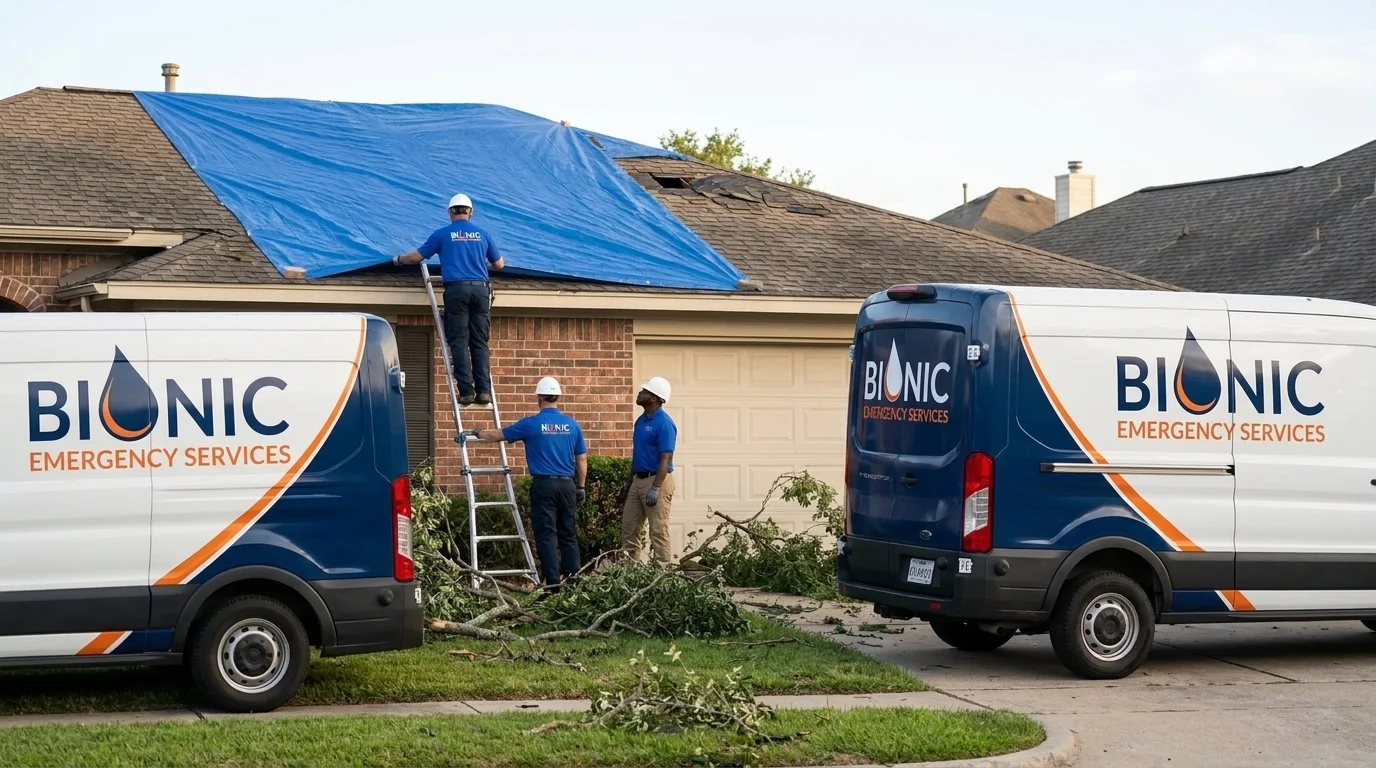
24/7 Emergency Storm Damage Restoration in Sugar Land
24/7 emergency storm damage restoration in Sugar Land, TX. IICRC-trained technicians, insurance billing accepted. Call (713) 338-2424.
Our IICRC-certified technicians are dispatched from our Houston, TX headquarters and are typically on-site in Sugar Land within 60 minutes of your call.
Storm damage emergency in Sugar Land? We answer 24/7. Call now and our crew heads out to secure the property and stop further damage.
Storm damage restoration in Sugar Land looks different depending on which side of town you’re on. A toppled live oak across a driveway in Sugar Creek is a different job than wind-driven rain forcing water under a roofline in Telfair, and both are different from the standing water that shows up near the Brazos River after a heavy band moves through. BIONIC handles the storm’s aftermath, from the tarp on the roof to the drywall that needs to come out.
Why Sugar Land Properties See Storm Damage Issues
Sugar Land sits close enough to the Gulf that tropical systems and their outer bands routinely bring straight-line wind and hours of sustained rain, not just a quick downpour. Mature tree canopy in established neighborhoods like First Colony and Sugar Creek means storm damage calls there often start with a limb or whole tree on a roof or fence line rather than water alone. Closer to the Brazos River and the Oyster Creek corridor that runs through parts of the city, saturated clay soil and high water tables slow drainage, so street and yard flooding can linger for a day or two after the storm itself has cleared. Newer construction in Riverstone and New Territory generally handles wind load better, but roof penetrations around solar panels and skylights are still a common point of water intrusion we see after a bad storm.
Our Storm Damage Restoration Process in Sugar Land
The first visit is about stopping further loss: emergency tarping or board-up on compromised roofs and windows, and extraction of any standing water inside the structure. From there we assess what’s actually wet versus what just looks wet, since storm water that’s pushed in through a soffit or window frame can travel along framing members well past where it entered. Structural drying follows the IICRC S500 standard, with moisture readings logged at the start and tracked through the job so drywall, insulation, and subfloor aren’t closed back up while still damp. Debris removal, whether it’s a downed fence section in Sugar Creek or shingles scattered across a First Colony yard, usually runs alongside the drying work rather than waiting until it’s finished.
Sugar Land Insurance & HOA Coordination
Many of Sugar Land’s planned communities, including Telfair, New Territory, and Riverstone, have HOA guidelines that cover exterior repairs, tree removal, and even temporary tarping materials and colors. We document the damage with photos and moisture logs before any tear-out begins, which helps both the insurance adjuster and, where needed, the HOA review process move faster. For homes near the Brazos River floodplain, carriers sometimes split damage between a standard homeowner’s policy and flood coverage, so we’re careful to document water lines and source of intrusion clearly from the first visit.
Local note
Sugar Land’s master-planned neighborhoods were largely built with retention ponds and underground drainage sized for routine rain, not for the debris a tornado or severe straight-line wind event leaves behind. After a bad storm, downed branches and shingle debris can clog inlets near Oyster Creek and the smaller drainage channels threading through Riverstone and New Territory, which means street flooding sometimes shows up a day or two after the sky clears, not during the storm itself. It’s worth a second look at low points on the property even after the initial cleanup feels done.
If a storm has left standing water, a damaged roofline, or downed trees on your Sugar Land property, BIONIC answers 24/7 and can start documentation and mitigation before the next round of weather moves through. Call (713) 338-2424 for storm damage restoration that accounts for how water actually moves through this part of the Gulf Coast.
Serving Sugar Land from our Houston headquarters — ★ 4.9 · 154 Google reviews
“I was out of town when one of our pipes began to leak. My wife was home and had to deal with the whole mess by herself. Our Bionic Project Supervisor, Tristan Rodriguez made the process easy to understand and walked my wife through the whole process to where she was comfortable. He explained…” — Marcus, May 2026Read our reviews on Google →
Storm Damage Restoration in Sugar Land: Service Coverage
Frequently Asked Questions
How fast can you arrive for storm damage restoration in Sugar Land?
How quickly can BIONIC respond to a storm damage call in First Colony or Sugar Creek?
Does Sugar Land's HOA structure affect storm repairs in communities like Telfair or New Territory?
Are homes near the Brazos River or Riverstone more prone to storm-related flooding?
What does your drying process involve after wind-driven rain gets into a home?
Will you handle the insurance side of a storm claim for a 77479 home?
Storm Damage Restoration response in Sugar Land
Most Sugar Land calls see a technician on-site within 60 minutes from our Houston headquarters.
Nearby & Related
- 24/7 Emergency Storm Damage Restoration in Houston
- Restoration Services in Sugar Land
- 24/7 Emergency Fire Damage Restoration in Sugar Land
- 24/7 Emergency Water Damage Restoration in Sugar Land
- 24/7 Emergency Storm Damage Restoration in Baytown
- 24/7 Emergency Storm Damage Restoration in Katy
- Contact BIONIC Emergency Services