
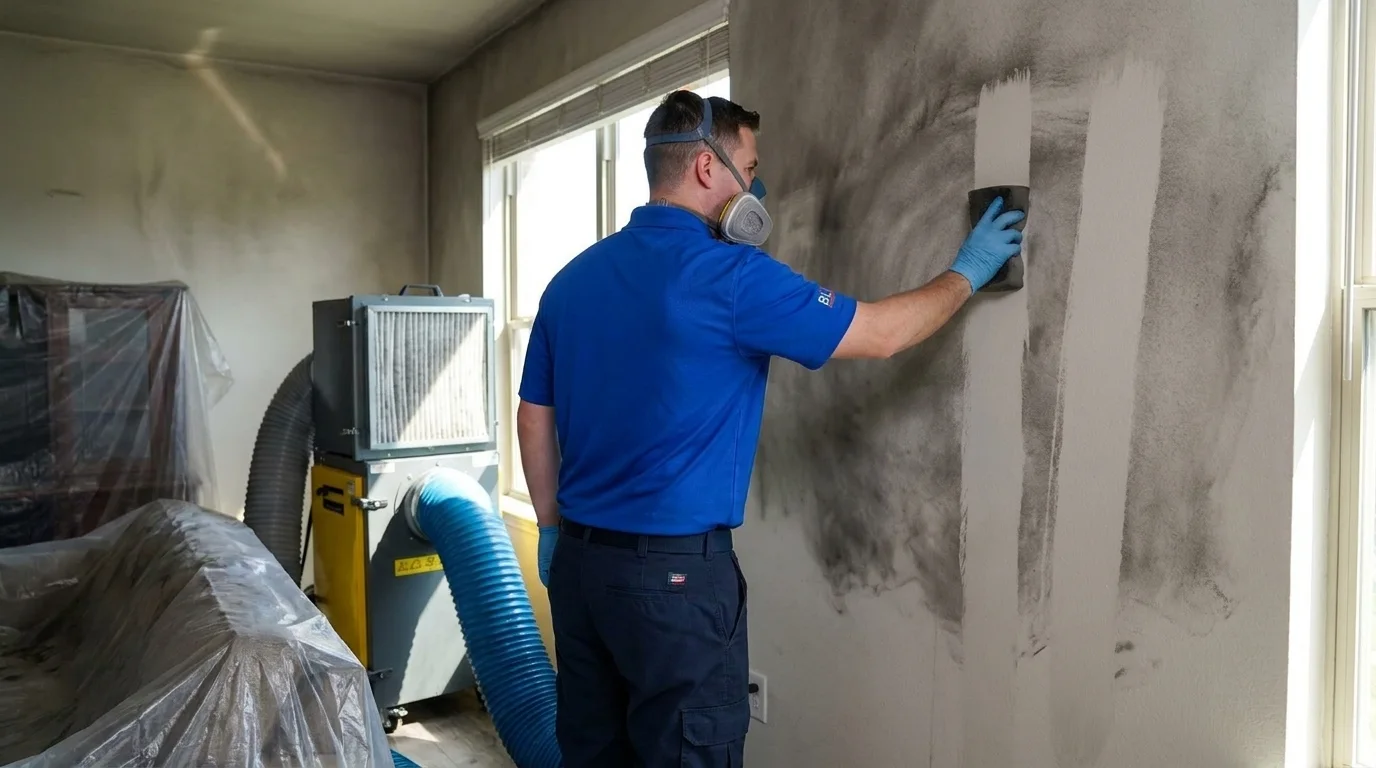
24/7 Emergency Smoke Damage Restoration in Houston
24/7 emergency smoke damage restoration in Houston and surrounding areas. IICRC-trained technicians, insurance billing accepted. Call (713) 338-2424.
Smoke damage emergency in Houston? Call (713) 338-2424 now. We answer 24/7 and start documenting and treating smoke-affected surfaces before residue has a chance to set permanently into paint, grout, and HVAC systems.
Smoke behaves differently than fire. Long after flames are out, soot particles keep working into drywall, cabinetry, and fabric, and the acidic film left behind by combustion can etch metal and yellow finishes within days if it’s not treated. A house can look cosmetically fine and still carry an odor that gets worse with humidity, because the particles trapped in porous materials keep off-gassing. That’s the problem smoke damage restoration solves: identifying where residue actually traveled, not just where the fire was, and removing it before it bonds permanently to the structure.
What smoke damage restoration actually involves
Smoke damage restoration is residue removal and odor neutralization, distinct from structural fire repair or rebuild work. It covers walls, ceilings, HVAC interiors, contents, and any cavity where smoke traveled through convection currents, which is often far beyond the visible burn area. The work uses dry chemical sponges, wet cleaning agents matched to the soot type, HEPA vacuuming, and odor-neutralization equipment like thermal foggers or hydroxyl generators. Timeline depends on soot type and how long it sat: a kitchen grease fire addressed within a day or two is a different job than a structure fire where residue has had a week to cure on surfaces.
Our process
- Soot and residue characterization. We identify whether the residue is dry smoke (fast-burning, powdery, easier to lift), wet smoke (smoldering, sticky, higher odor potential), or protein smoke (near-invisible but extremely pungent, common after kitchen fires), because each requires a different cleaning agent and technique.
- Pre-cleaning and surface treatment. Dry soot gets HEPA-vacuumed and sponge-cleaned before any wet method touches it; using water or wet chemicals first on dry smoke residue can smear soot deeper into the material instead of lifting it.
- Thermal fogging or odor neutralization. For odor molecules that have penetrated porous materials, we use thermal fogging or hydroxyl/ozone treatment to neutralize smoke odor at the molecular level rather than masking it with fragrance.
- Sealing and encapsulation. Porous surfaces that can’t be fully cleaned, like char on framing or deeply stained subfloor, get sealed with an odor-blocking encapsulant before any finish work goes back over them.
- Contents evaluation and HVAC check. Soft goods, electronics, and HVAC ductwork get inspected separately, since duct systems recirculate smoke odor through a home long after visible soot is gone if they’re not cleaned or filtered.
What separates a good smoke damage response from a bad one
The most common mistake is treating smoke damage as a surface cleaning job instead of a chemistry problem. Soot residue is acidic, and the longer it sits, especially in Houston’s humidity, the faster it etches metal fixtures, yellows grout, and bonds into paint film. Crews that skip proper soot characterization often use the wrong cleaning agent, which can smear residue instead of lifting it or set an odor permanently into drywall. Masking odor with fragrance instead of neutralizing it at the source is another shortcut that fails inspection and resurfaces within weeks. Adjusters reviewing a smoke damage claim typically look for documented pre- and post-cleaning photos, a clear scope separating cleanable versus non-salvageable materials, and evidence that HVAC systems were addressed, not just visible rooms.
What does smoke damage restoration cost?
Costs vary with soot type, how far smoke traveled through the structure, and how long residue sat before treatment started. These are typical industry ranges, not a quote: every loss is different, and BIONIC Emergency Services provides a written scope of work before any cleaning begins. Homeowners insurance typically covers smoke damage restoration when it results from a covered fire event, though coverage for odor-only claims without visible soot can vary by policy.
| Scenario | Typical range |
|---|---|
| Light surface smoke, single room | $500 - $1,500 |
| Moderate smoke across multiple rooms | $2,000 - $6,000 |
| Heavy soot, whole-house fire aftermath | $8,000 - $25,000+ |
| Contents cleaning and pack-out (per room) | $300 - $900 |
| HVAC and duct smoke decontamination | $450 - $1,200 |
| Odor neutralization treatment (ozone/hydroxyl) | $300 - $800 |
Seasonal & regional considerations
Houston’s humidity accelerates the chemistry that makes smoke damage worse the longer it waits. Acidic soot residue reacts faster with moisture in the air, which means metal corrosion and grout staining can progress within days rather than weeks. The region also sees periodic wildfire smoke drift from regional brush fires, which can leave a fine haze and persistent odor inside homes that never had an actual fire on the property, settling into HVAC filters and soft furnishings the same way structure-fire smoke does.
Service area
BIONIC Emergency Services handles smoke damage restoration across Houston and the surrounding communities throughout the metro area.
If smoke odor or soot residue is spreading through your home, don’t wait for it to set into your walls and finishes. Call (713) 338-2424 to begin smoke and soot removal and get a written scope before any cleaning starts.
Services We Handle
- Soot Removal
Frequently Asked Questions
Does homeowners insurance cover smoke damage restoration?
What's the difference between protein soot and synthetic soot, and why does cleanup vary?
How soon after a fire does smoke odor become permanent?
Can wildfire smoke infiltrate a home that wasn't directly burned?
What happens to HVAC systems after a smoke event?
Looking for the best smoke damage restoration company in Houston?
BIONIC Emergency Services provides smoke damage restoration in Houston, TX and the surrounding area, and has served local property owners since 2011. Customers rate us 4.9 out of 5 stars across 154 Google reviews. We answer calls 24/7 — call (713) 338-2424 for immediate help.
Need Smoke Damage Restoration now?
We respond 24/7 across Houston and surrounding TX cities.