
Pipe burst and water is spreading fast? Call now for emergency service at (713) 338-2424. Shut off your main water valve first, then work through the steps below while you wait.
A burst pipe can dump hundreds of gallons into a home in under an hour, and in Houston’s slab-foundation houses that water often has nowhere to go but sideways, under flooring and into wall cavities. The single most important action is shutting off the water at the main valve, not just the fixture nearest the leak. After that, the priority shifts to limiting how far the water travels and documenting the damage before cleanup starts.
Why This Happens in Houston Homes
Most burst pipes here trace back to one of three causes: a hard freeze that splits copper or galvanized supply lines (the kind Houston saw citywide in February 2021), a slab leak where a pipe embedded in the foundation corrodes or shifts, or a sudden pressure spike in an aging section of plumbing. Homes built before the 1980s often still have original galvanized pipe, which corrodes from the inside out and can fail without warning even on a mild day. Newer PEX plumbing is more freeze-tolerant but isn’t immune if a line runs through an unconditioned attic or garage wall.
The water itself behaves differently depending on where the break is. A supply line under a sink floods visibly and fast. A break inside a wall or under a slab can run for hours before you notice a damp baseboard, a warm spot on the floor, or a water bill that jumps unexpectedly.
Immediate Steps to Take
- Shut off the main water valve. It’s usually near the street-side hose bib, in a utility closet, or where the line enters the house. Turning off a single fixture valve won’t stop a burst supply line elsewhere in the system.
- Kill the power to the affected area at the breaker if water is near outlets, switches, or light fixtures. Don’t do this standing in water.
- Move anything you can lift. Furniture, rugs, boxes, electronics. Wood furniture left sitting in water can swell and delaminate within a few hours.
- Start removing standing water. A wet/dry shop vac, towels, or a mop bucket works for small volumes. For more than an inch or two of standing water, extraction equipment does a faster, more complete job than anything in a typical garage.
- Photograph everything before you clean. Wide shots of the room, close-ups of the source, and anything damaged. Insurance adjusters rely heavily on this documentation, and it’s much harder to reconstruct after the fact.
- Open interior doors and run air conditioning or fans if the weather allows, to start pulling moisture out of the air. Houston’s humidity works against you here, so don’t expect a box fan alone to dry a soaked subfloor.
What Not to Do
- Don’t turn the water back on to “test” the pipe. If it burst once under normal pressure, it can burst again the moment you restore flow.
- Don’t use a household vacuum that isn’t rated for wet pickup. It can short out or shock you.
- Don’t ignore a musty smell because the surface looks dry. Carpet pad, subfloor, and the underside of baseboards hold moisture long after the visible surface feels fine.
- Don’t assume a slab leak is resolved just because the puddle disappeared. Water can migrate laterally under the foundation and resurface somewhere else in the house days later.
- Don’t wait on drywall and insulation that have been saturated. Wet insulation loses its R-value and rarely dries fully in place; it usually needs to come out.
When to Call a Professional
A wet-vac and some box fans can handle a small, caught-early leak, like a quarter-cup spill under a sink. Call a restoration company when any of the following apply:
- Water has been running for more than a few minutes unattended, or you’re not sure how long it ran before you found it.
- The water reached carpet, carpet pad, or crossed from one room into another.
- You can’t tell whether water got into the wall cavity or under the flooring.
- The source was a slab leak, a line inside a wall, or anything behind a finished surface.
- You smell a musty or earthy odor, which usually means moisture has already been sitting for a while.
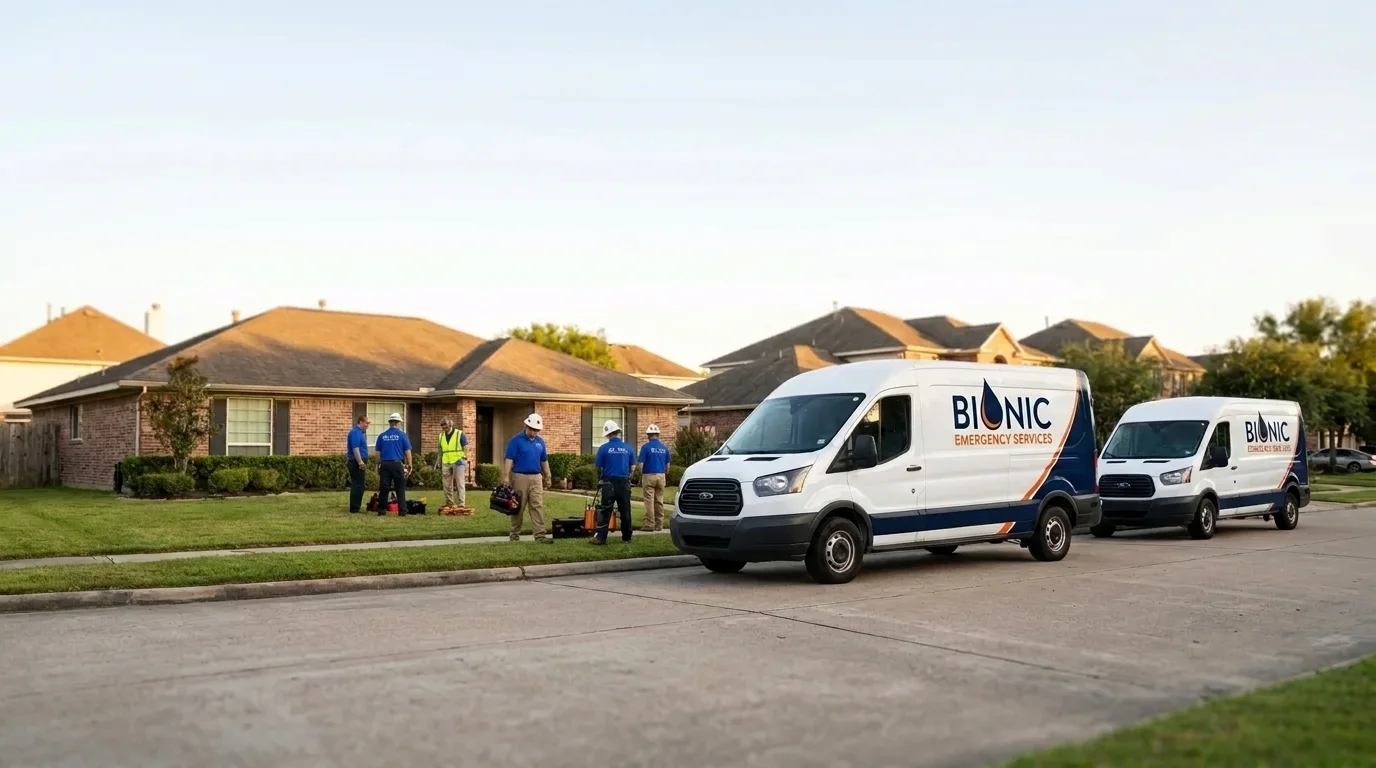
A professional response typically starts with moisture mapping, using a meter to check how far water has traveled into drywall, baseboards, and subfloor, since a damp patch on the surface often hides a much larger wet area behind it. From there, extraction equipment pulls out standing water, and industrial air movers and dehumidifiers are positioned to dry the structure in place rather than guessing with household fans. BIONIC Emergency Services handles this kind of water damage restoration in Houston, and if the burst happened at an appliance connection, like a washing machine hose or a dishwasher supply line, that falls under appliance leak cleanup, which follows a similar process but focuses on the kitchen or laundry area specifically.
The Recovery Process After the Water Is Out
Once standing water is removed, the real work is drying the structure, not just the surface. Drywall, baseboards, and subfloor that look dry to the touch can still hold significant moisture inside the material. That’s why drying crews use moisture meters to track progress over several days rather than pulling equipment the moment a room looks dry. Materials that were soaked for an extended period, like swollen particleboard cabinets or saturated carpet pad, usually get removed rather than dried in place, since they rarely return to their original condition even after drying.
If you’re filing an insurance claim, keep every receipt related to the incident, from the cleanup equipment you rented to any temporary repairs. Most homeowner policies cover sudden and accidental water damage from a burst pipe, though coverage for the plumbing repair itself versus the resulting water damage can be handled differently, so it’s worth asking your adjuster directly how the claim is being split.
A burst pipe is stressful in the moment, but the steps that matter most, shutting off water fast and getting moisture out before it spreads, are the same whether the break happened five minutes ago or you just found it this morning. If you’re past the point where towels and fans are enough, BIONIC Emergency Services can be reached at (713) 338-2424 to talk through what you’re seeing and whether on-site help makes sense.