
Homeowners insurance generally covers water damage when it happens suddenly and accidentally, like a pipe that bursts overnight or a washing machine hose that fails. It typically does not cover damage from gradual leaks, poor maintenance, or flooding from an outside source, which is a separate policy altogether. The distinction between “sudden” and “gradual” is the single biggest factor an adjuster will weigh, and it’s worth understanding before you ever need to file a claim.
What Your Policy Actually Covers
Most standard homeowners policies (HO-3 being the most common form) cover water damage that is both sudden and accidental. Think a supply line that lets go behind the washer, a water heater tank that splits, or a pipe that freezes and cracks during a cold snap. In these cases, the policy generally pays to repair the source-related damage (drywall, flooring, cabinetry) and to dry the structure, minus your deductible.
What the policy usually will not touch is damage that built up over time. If a toilet supply line has been seeping for months and the subfloor finally gives out, an adjuster may classify that as a maintenance issue rather than a covered loss. The logic insurers use is straightforward: they cover what you couldn’t reasonably have prevented, not what should have been caught during routine upkeep.
Common Scenarios and How They’re Usually Treated
- Burst or frozen pipe: Usually covered, including the cost to access the pipe (cutting drywall) and repair the surrounding materials.
- Appliance or supply line failure: Usually covered if the failure was sudden, like a dishwasher hose rupturing mid-cycle.
- Roof leak during a storm: Often covered under wind or storm damage provisions, but the insurer may ask whether the roof was already compromised before the storm.
- Sewer or drain backup: Not covered under a standard policy. This requires a separate sewer backup endorsement, which many Houston-area homeowners add given the city’s older sanitary infrastructure in some neighborhoods.
- Flooding from rising water, storm surge, or overflowing bayous: Never covered by homeowners insurance. This is flood insurance territory, typically through the National Flood Insurance Program or a private flood carrier.
In a city where heavy rain events and tropical systems are part of the yearly calendar, that last distinction trips up a lot of homeowners. Water damage and flood damage sound like the same thing from your living room floor, but to an insurer they’re entirely different policies with entirely different coverage triggers.
What Usually Isn’t Covered
- Gradual leaks that occurred over weeks or months, even if you didn’t know about them
- Damage from flooding, storm surge, or groundwater intrusion (flood insurance territory)
- Sewer or drain backup without a specific endorsement
- Damage tied to deferred maintenance, like a known roof issue or a pipe you were told needed replacing
When to Call a Professional
If you’ve found standing water, a damp smell that won’t go away, or a stain spreading across a ceiling or wall, it’s worth getting a second set of eyes before you decide what the damage means. A professional water damage restoration crew can tell you whether moisture has reached the subfloor or wall cavity, which isn’t always obvious from the surface, and that assessment is useful whether or not you end up filing a claim.
It’s also worth calling before you start tearing out materials yourself. Cutting into drywall or pulling up flooring without documentation first can complicate a claim, since the adjuster needs to see (or have photos of) the extent of the damage before repairs begin.
The Claims and Recovery Process
- Stop the source if you safely can. Shut off the water supply to the fixture or the main valve if the source isn’t obvious.
- Document everything before you touch anything. Photos and video of the water, the affected materials, and anything damaged (furniture, flooring, baseboards) give your claim a foundation.
- Call your insurance company to open a claim. Ask what your policy covers, what your deductible is, and whether they need you to get repair estimates from licensed vendors.
- Get a professional assessment of the moisture. Drywall, subfloor, and insulation can hold water long after the surface looks dry, and an assessment using moisture meters gives you (and the insurer) real numbers instead of guesswork.
- Begin drying and mitigation. The faster standing water and saturated materials are addressed, the lower the risk of secondary damage like warped flooring or swollen cabinetry, especially in a warm, humid climate like Houston’s.
- Track the repair timeline. Most claims move faster when the homeowner keeps a simple record: when the leak was found, when mitigation started, and when repairs were completed.
None of this requires you to be an insurance expert. It just requires moving in the right order: stop the water, document it, call the carrier, and get the structure drying before the clock works against you.
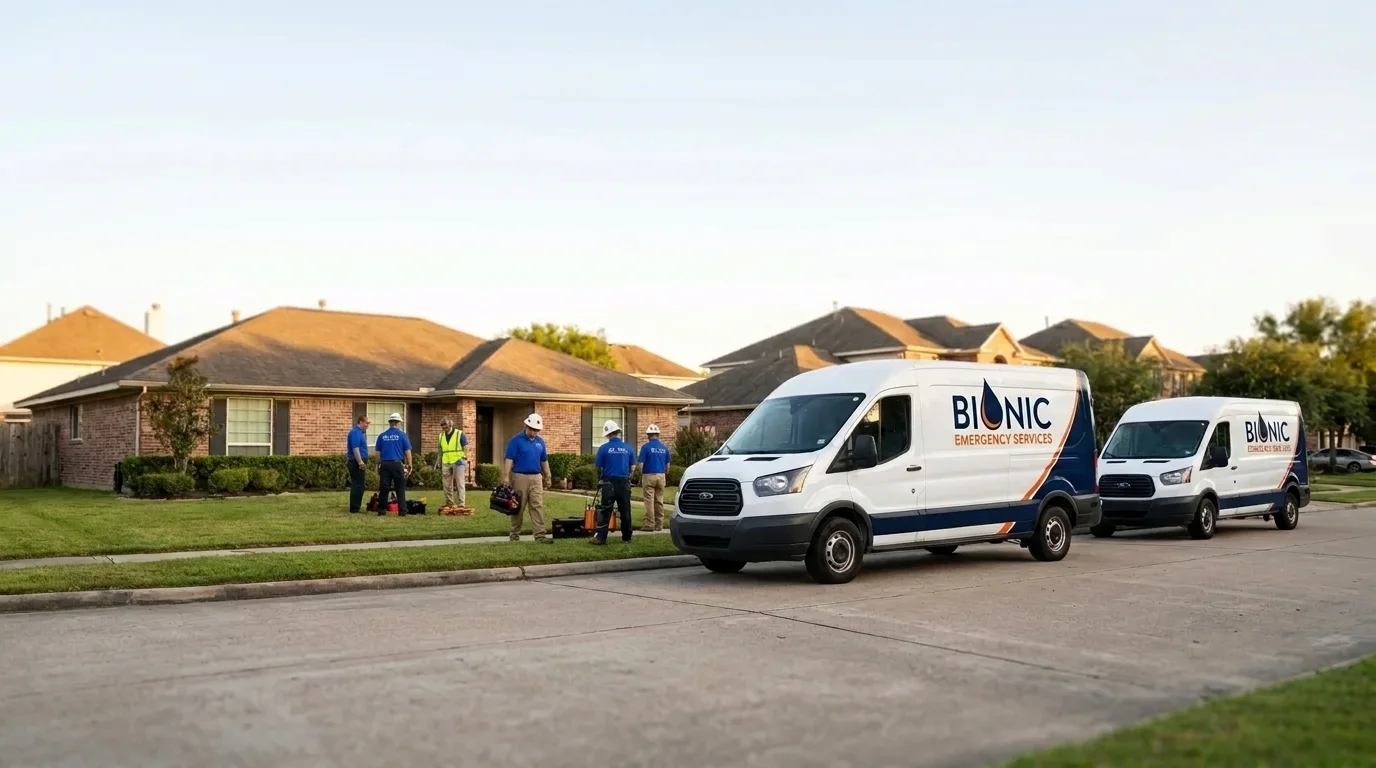
If you’re staring at a wet ceiling or a soaked carpet and trying to figure out what happens next, BIONIC Emergency Services provides water damage restoration for Houston homeowners and can help document the loss and begin drying the structure. Call (713) 338-2424 to talk through what you’re seeing and what steps make sense for your situation.