
Water damage gets worse by the hour, not the day. In the first 24 hours after a pipe bursts, a water heater fails, or storm water gets into your home, your job is to stop the source, protect yourself from electrical and structural hazards, remove as much standing water as you can, and start documenting everything for your insurance claim. The faster air starts moving through the affected area, the better your odds of avoiding warped flooring and drywall that has to be torn out instead of dried and repaired.
What’s Actually Happening in Those First Hours
Water doesn’t stay where it lands. It wicks up drywall through capillary action, soaks into subfloor through seams and nail holes, and runs along floor joists to parts of the house nowhere near the original leak. If you can hear water but can’t see it, it’s probably already under your flooring or inside a wall cavity. Carpet padding holds water like a sponge and starts breaking down within a day. Houston’s humidity doesn’t help: even a small leak in a home here stays wetter, longer, than the same leak would in a dry climate, because the surrounding air is already saturated for much of the year. That’s part of why the window for easy drying is so short.
Immediate Steps to Take
- Shut off the water source. For a burst pipe or supply line, close the fixture’s shutoff valve or the home’s main valve. For a water heater failure, shut off both the water supply and the gas or electric power to the unit.
- Cut power to the affected area if there’s any chance water has reached outlets, switches, or light fixtures. Use the breaker panel rather than touching switches in a wet area. If you’re not confident doing this safely, wait for an electrician or restoration crew before entering.
- Move anything you can lift. Furniture, rugs, electronics, and boxes should come off wet flooring immediately. Wood furniture left sitting in water will cup and stain within hours.
- Start removing standing water. A wet/dry shop vac handles small amounts. For a flooded room, towels and a mop buy you time, but they won’t get water out of carpet padding or under baseboards.
- Open windows and run fans if the weather allows it. In Houston, outdoor humidity is often high enough that this helps less than people expect, especially in summer. Air conditioning actually does more to pull moisture out of the air than an open window does.
- Photograph everything before you move or discard anything. Wide shots of the room, close-ups of damaged materials, and the source of the leak itself. Insurance adjusters rely heavily on early documentation, and it’s much easier to take these photos before cleanup starts than to reconstruct what happened later.
- Check for secondary damage. Look at the ceiling below an upstairs leak, baseboards along affected walls, and anything stored in a basement or crawlspace under the leak path.
What Not to Do
- Don’t use a regular household vacuum on standing water. It’s not built for it and the shock risk is real.
- Don’t ignore a wet ceiling, waiting for it to “dry on its own.” A sagging or stained ceiling means water is pooling above it, and it can collapse with very little warning.
- Don’t run a dehumidifier in a closed room with no air movement and call it handled. Dehumidifiers work alongside air movers, not as a substitute for them, and a single consumer unit isn’t sized for a flooded room.
- Don’t assume carpet that “feels dry on top” is fine. Padding underneath holds moisture far longer than the carpet fiber does, and that’s exactly where lingering moisture problems start.
- Don’t throw away damaged materials before documenting them, even if you’re eager to start cleaning up. Your insurer may ask for the damaged items or detailed photos as part of the claim.
- Don’t paint or patch drywall over a spot that was recently wet. If the wall isn’t fully dry behind the surface, you’re sealing moisture in, not fixing anything.
When to Call a Professional
A small, contained leak that you caught immediately, like a dropped glass of water or a minor sink overflow, is often something you can dry yourself with towels, fans, and a couple of days of attention. Call a restoration company when any of the following is true:
- Water has been sitting for more than a few hours, or you don’t know how long it’s been there
- The water came from a source you’d rather not touch, like a toilet overflow or sewer backup
- Water reached a wall cavity, subfloor, or ceiling, where you can’t fully see or dry it yourself
- You’re dealing with more than a room’s worth of flooring
- There’s any chance the water contacted electrical systems
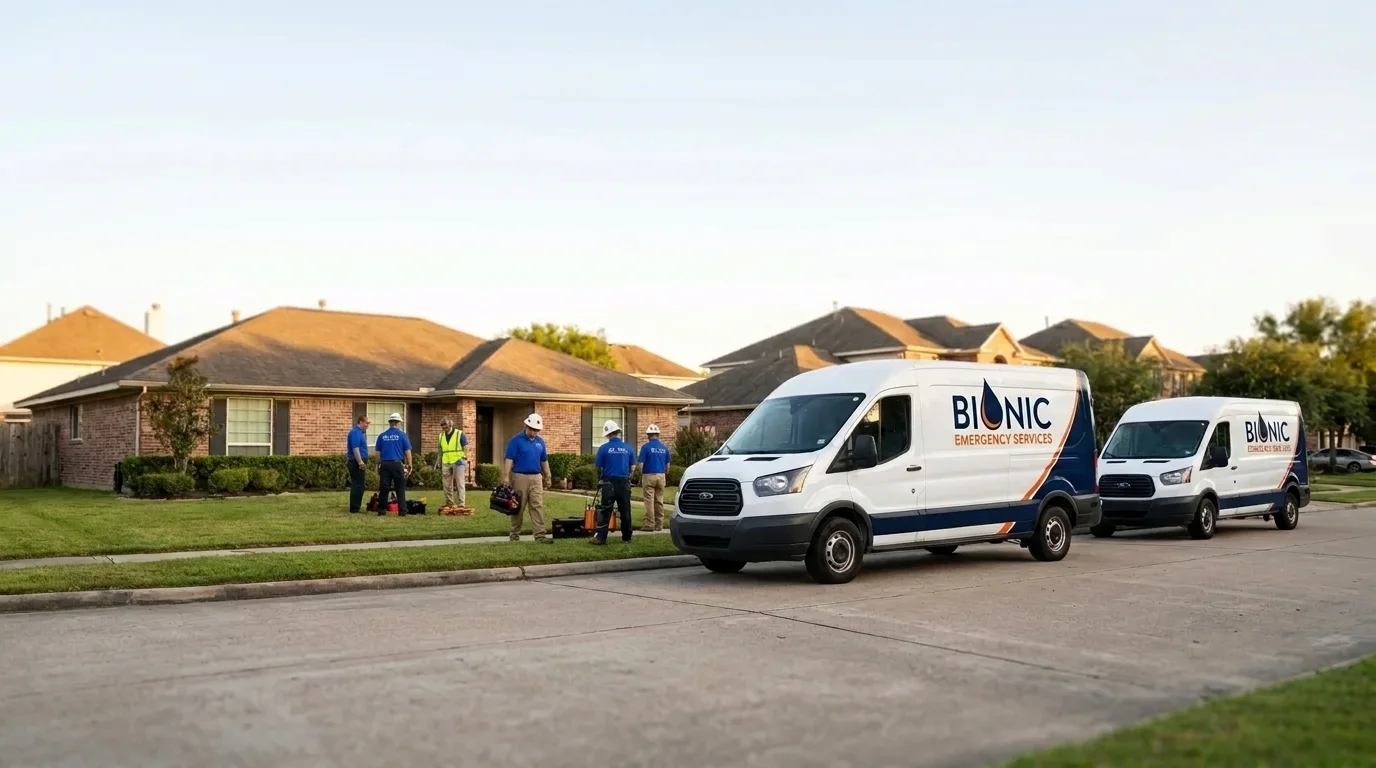
This is where professional water damage restoration earns its keep. BIONIC Emergency Services uses moisture meters and thermal imaging to find water that’s traveled behind walls or under flooring, not just what’s visible on the surface, and sets up commercial air movers and dehumidifiers sized for the actual volume of water involved. That equipment moves air and pulls moisture at a scale a box fan and a bagless vacuum can’t match, which is the difference between materials that dry out intact and materials that have to be demolished and replaced.
The Recovery Timeline After Day One
Once the source is stopped and extraction is underway, drying itself typically plays out over several days, not hours. Materials are monitored with moisture meters at intervals to confirm they’re actually drying, not just feeling dry to the touch, with equipment adjusted and sometimes relocated as readings change. Structural materials like studs and subfloor often take longer to reach a safe moisture level than the surfaces around them, which is why a restoration crew will usually recommend leaving drying equipment in place a few days even after the space looks and feels dry. Only once moisture readings are back to normal does it make sense to start repairs like replacing drywall, baseboards, or flooring. Houston’s slab-on-grade construction, common in homes built from the 1950s onward, means water from a slab leak often shows up as a damp or warm spot on the floor well before any wall damage is visible, so if you’re seeing that pattern, the clock on drying starts the moment you notice it, not when the damage becomes obvious.
If you’re standing in a wet room right now trying to decide what to do next, start with the steps above: stop the source, protect yourself from electrical risk, get water moving out of the space, and document what you see. For anything beyond a small, contained spill, a quick call puts a trained eye on the situation before the damage spreads any further. BIONIC Emergency Services can be reached at (713) 338-2424 to talk through what you’re seeing and whether it’s time to bring in equipment.